%20%20-%20Menu.svg)




.png?width=879&height=549&name=Page%2074%20(1).png)



In this blog
TL;DR – The Best Post-Purchase Experience Platforms in 2026
-
ClickPost - Best overall — global post-purchase platform with 600+ carriers, strong at tracking and returns
-
parcelLab – Best for European cross-border CX-led messaging
-
Narvar – Best for enterprise North American retail with high return volumes
-
AfterShip – Best for Shopify SMBs needing fast setup
-
ZigZag Global – Best for cross-border international returns
-
Sendcloud – Best for European multi-carrier shipping operations
-
WeSupply Labs – Best for omnichannel retailers with BOPIS/BORIS flows
-
Outvio – Best for high-volume operators consolidating tools
-
LateShipment – Best for shipping audit and carrier refund recovery
-
Parcel Perform – Best for enterprise global delivery analytics
Why Post-Purchase Is Now Your Biggest Retention Lever (And Where Most Brands Fail)
Most brands obsess over acquisition and conversion. Then the order ships, and the customer is pushed to a carrier page, left to guess amid delays, partial deliveries, and vague scans. That gap is where loyalty gets won or quietly lost.
Research consistently shows that the post-purchase stage drives repeat behaviour. In consumer research, 79% of shoppers said they would not purchase from a retailer again after a poor post-purchase experience. Similarly, 93% said post-purchase is important when deciding whether to shop with a retailer again.
At the same time, customer expectations have shifted from “tell me when it ships” to “keep me confidently informed until it is in my hands.”
That is why post-purchase experience platforms have become a distinct category. They sit between your storefront and your carriers to create a branded, controlled layer for order visibility, shipping notifications, delivery exceptions, returns and exchanges, and analytics. Done well, they reduce WISMO (Where Is My Order?) pressure on support, boost customer retention, and create a post-sale engagement surface you actually own.
What Is a Post-Purchase Experience Platform?
A post-purchase experience platform is the operations and CX layer that runs everything between checkout and delivery resolution. That includes order visibility, shipping notifications, delivery exception handling, returns, exchanges, and the analytics that tie all of it back to retention.
These platforms replace the mess most brands live with — carrier tracking pages that look like 2008, generic shipped/delivered emails, and RMA threads buried in support inboxes — with a single system. Customers get a self-service hub for tracking and returns. Operators get rule-based control over messaging cadence, exception triggers, multi-carrier orchestration, and a dashboard that connects delivery performance to repeat purchase behavior.
The 6 Core Functions of a Post-Purchase Platform
Most post-purchase experience platforms combine the same building blocks, then differentiate on depth and integrations:
-
Order tracking and visibility: Branded tracking page, shipment status history, and support for split shipments and multiple tracking numbers.
-
Shipping notifications: Automated email alerts and SMS notifications for key milestones (shipped, out for delivery, delivered) plus exception events.
-
Delivery exceptions and issue workflows: Rules and triggers for delayed scans, failed delivery attempts, address issues, or lost packages, often with customer-facing resolution steps.
-
Returns and exchanges: A self-service portal, RMA workflows, label creation, and exchange management options like store credit incentives.
-
Performance analytics: Carrier performance, on-time delivery rates, WISMO reduction signals, return reasons, and operational bottlenecks.
-
Integrations and APIs: Connections with Shopify and other commerce platforms, helpdesks, marketing tools, 3PLs, and carrier networks.
Why Post-Purchase Drives Retention, WISMO Deflection, and CLV
Post-purchase is the moment trust either hardens or breaks. The customer has already paid. They are emotionally invested but anxious. Is the package moving? Will it arrive on time? What happens if it doesn't? When your platform answers those questions clearly, support tickets drop and reorder rates climb. When it doesn't, the support inbox becomes a queue of "where is my order" tickets, and the next purchase quietly goes to a competitor.
The economics work in three places:
-
Retention and CLV. Clarity reduces post-purchase regret, and clarity at scale only happens with proactive comms tied to real shipment events.
-
WISMO deflection. Industry benchmarks put WISMO at 20–40% of all ecommerce support volume. A good tracking page plus proactive notifications typically cuts that by half within a quarter.
-
Return economics. A self-service portal that defaults to exchanges or store credit can convert 25–40% of refund intent into retained revenue, depending on category.
-
A working post-purchase stack sits on top of solid [INTERNAL: ecommerce shipping software → /shipping-software-slug] — the carrier connectivity, dispatch automation, and shipment data layer that powers everything customers see downstream.
The Top 10 Post-Purchase Experience Platforms for 2026
Post-purchase experience platforms sit between “order placed” and “order delivered” and decide whether that gap feels calm or chaotic. The best tools do three things consistently: keep customers updated in your brand voice, surface exceptions before customers complain, and turn tracking and returns into a retention layer rather than a support burden.
Quick Comparison: Post-Purchase Platforms by Features, Pricing & G2 Rating (2026)
| Platform | Best For | Starting Price | Carriers | G2 Rating |
| ClickPost | Multi-carrier orchestration, emerging-market scale, shipping-led PPX | Custom | 600+ | 4.7 |
| parcelLab | Enterprise cross-border CX | ~€2,400/month | 350+ | 4.6 |
| Narvar | Enterprise retail, drop-off network | Custom | 1,000+ | 4.3 |
| AfterShip | SMB to mid-market Shopify brands | $0 → $11+/month | 1,200+ | 4.7 |
| ZigZag Global | Cross-border returns | Tiered + per-return | 200+ | 4.6 |
| Sendcloud | EU-first shipping + PPX | €0 → €49/month | 80+ EU | 4.6 |
| WeSupply Labs | Omnichannel mid-market | ~$60/month | 100+ | 4.5 |
| Outvio | Tool consolidation (shipping+returns+support) | ~$125/month | 90+ | 4.8 |
| LateShipment | CX + parcel audit recovery | ~$13/month/module | Major global | 5 |
| Parcel Perform | Enterprise delivery intelligence | Custom | 1,000+ | 4.7 |
| Loop Returns | Returns-heavy Shopify brands | ~$155/month | Stack-dependent | 4.7 |
How We Evaluated These Platforms: Methodology & Scoring Criteria
This shortlist is for people who ship at scale and handle delivery exceptions, not for keyword padding.
How we built it
-
Prioritized platforms that cover tracking, notifications, returns, and exception handling in a coherent workflow
-
Looked for operational depth: carrier performance visibility, automation controls, and measurable WISMO reduction levers
-
Evaluated integration reality: Shopify and major commerce platforms, carrier breadth, and API maturity
-
Compared pricing models by stage (SMB, mid-market, enterprise) to reflect what teams can actually adopt
Kept ClickPost unranked here because it is best positioned as a complementary execution layer for shipping performance and logistics orchestration, not as a pure PPX suite.
1. ClickPost — Best Post-Purchase Experience Platform for DTC Brands
ClickPost ranks first because it solves what most PPX platforms only paper over: the post-purchase experience is only as good as the shipping data behind it. Branded tracking, proactive notifications, and exception alerts all break down when carrier data is stale or NDR attempts go unmanaged.
ClickPost is built as a post-purchase experience platform with a carrier data layer underneath — 600+ carrier integrations with real-time webhooks feeding every customer-facing surface, so the PPX layer never runs on bad data.
For brands shipping at meaningful volume across India, Southeast Asia, and the USA — where last-mile complexity drives WISMO tickets and RTO losses — ClickPost owns the full post-purchase journey: branded tracking, customer notifications, exception management, NDR recovery, and returns.
Key features
- Branded tracking page with split-shipment support, FAQ blocks, and product recommendation widgets for post-purchase merchandising
- Multi-channel customer notifications across email, SMS, and WhatsApp with exception-first templates and cadence controls
- Automated NDR management that routes failed deliveries to customer self-service before re-attempt, recovering shipments before they turn into RTOs
- Returns and exchanges portal with rule-based eligibility and exchange-first defaults to protect revenue
- Proactive exception alerts that flag delays and stuck shipments before the customer raises a WISMO ticket
- Post-purchase analytics covering on-time delivery rate, NPS, exception frequency, and return reasons
Best for: Mid-market and enterprise D2C brands, marketplaces, and 3PLs that need a unified post-purchase experience across complex carrier networks — especially where NDR, RTO, and WISMO are material cost lines.
Integrations: Shopify, Shopify Plus, Magento, WooCommerce, Salesforce Commerce Cloud, Unicommerce; Klaviyo, Gorgias, Zendesk, Freshdesk; major WMS and OMS platforms.
Pricing: Custom, structured by shipment volume and module mix. Operators with significant volume typically see TCO well below stitched-together stacks of branded tracking, notification, and returns tools.
Pros
- Unifies the entire post-purchase experience — tracking, notifications, exceptions, returns — on one platform instead of stitching together point tools
- Carrier data reliability is unmatched in emerging-market lanes, which is where most PPX tools fail silently
- NDR and RTO automation pay for the platform on their own in COD-heavy categories
- API maturity makes it a defensible choice for engineering-led teams scaling across geographies
Cons
- Not the right fit for early-stage Shopify stores doing fewer than ~5,000 monthly shipments
- Onboarding involves carrier mapping work that simpler tracking-only apps skip
2. parcelLab
2. parcelLab
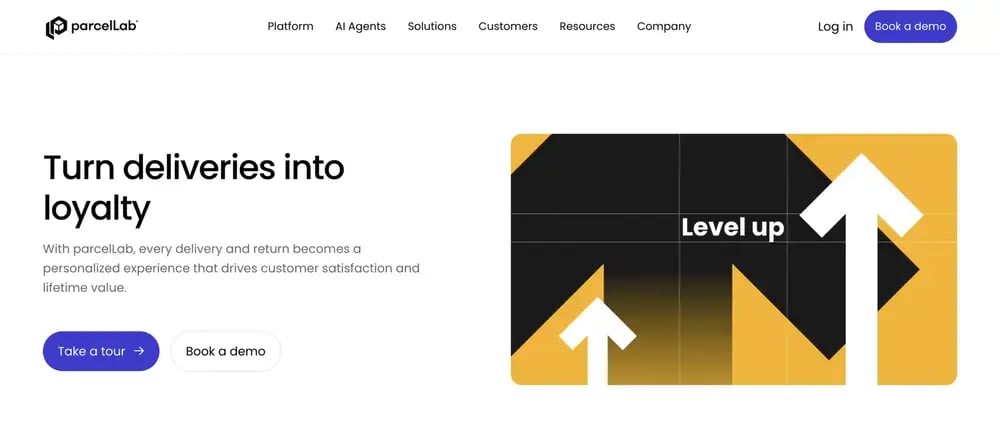
parcelLab is the strongest CX-led platform on the list and the right pick for brands whose shipping execution is already solid but whose post-checkout messaging is fragmented. It's particularly strong across European cross-border lanes and for retailers who want fully white-labelled tracking with proactive comms baked in.
Key features
- White-labelled tracking on your own domain
- Multi-channel notifications (email, SMS, WhatsApp) with milestone and exception triggers
- Returns portal with exchange and store credit flows
- Journey-level analytics and carrier benchmarking
Best for: Mid-market and enterprise brands shipping cross-border in Europe and North America.
Integrations: Shopify, Magento 2, Shopware, Salesforce Commerce Cloud; Zendesk, Kustomer, Gorgias; Klaviyo, Postscript; 350+ carriers.
Pricing: From around €2,400–€3,333/month, custom by volume and modules.
Pros: Strong brand control, proactive exception visibility, genuinely operational analytics.
Cons: Not viable for early-stage stores. Implementation runs 8–12 weeks if your stack is non-standard.
3. Narvar
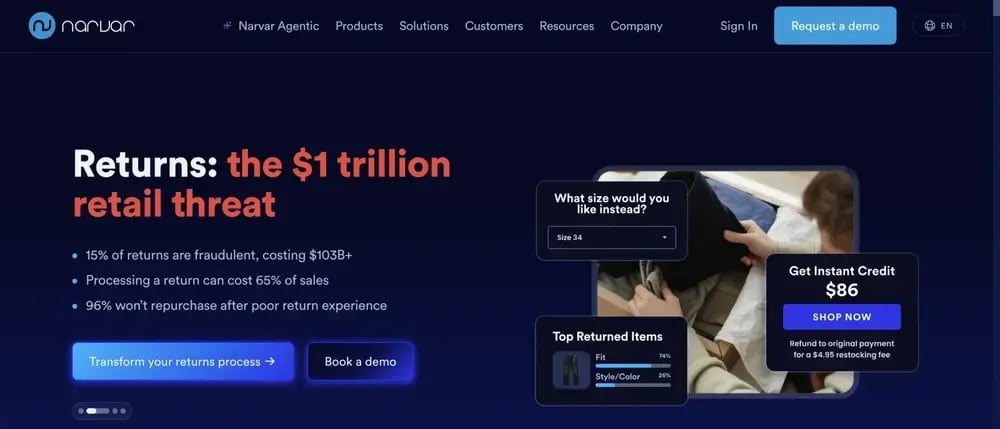
Narvar is the incumbent enterprise choice in North American retail. It treats post-purchase as a loyalty engine and has the most mature ecosystem for in-person returns drop-off, fraud and claims handling, and high-volume operations.
Key features
- Branded tracking pages with merchandising surfaces
- Proactive notifications and delivery promise overlays
- Returns and exchanges portal optimized for revenue retention
- Drop-off network with boxless and label-free options where supported
- Fraud and claims tooling for loss control
Best for: Enterprise retailers with high shipment volume and complex returns.
Integrations: Shopify Plus, Salesforce Commerce Cloud, Magento, BigCommerce; Zendesk, Salesforce Service Cloud, Gladly; 1,000+ carriers.
Pricing: Custom enterprise, priced by volume and module mix.
Pros: End-to-end depth at scale, strong North American returns network, mature exception tooling.
Cons: Long implementation cycles. Cost and complexity rule it out for sub-enterprise teams.
4. AfterShip
AfterShip is the default Shopify-first PPX choice and the easiest to get live in a week. The free tier is real, the paid tiers stack features cleanly, and the upgrade path from tracking to notifications to returns to AI-powered EDD is well-engineered.
Key features
- Branded tracking pages and widgets with merchandising blocks
- Automated email and SMS milestone alerts plus exception messaging
- Multi-carrier shipment visibility dashboard
- Returns module with RMA, label generation, and exchange flows
- AI-driven estimated delivery dates on higher tiers
Best for: SMB to mid-market Shopify brands scaling support load.
Integrations: Shopify, WooCommerce, Magento 2, BigCommerce; Klaviyo, Attentive, Gorgias, Zendesk, Yotpo; Amazon, eBay; 1,200+ carriers.
Pricing: Free tier, then $11/month entry, with mid-tiers at $119–$199/month and enterprise custom.
Pros: Fast setup, broad carrier coverage, clean upgrade path.
Cons: Higher-value features sit behind upper tiers. Costs scale quickly with volume and add-ons.
6. ZigZag Global
ZigZag is returns-led, cross-border-first, and the right choice when international returns are eating margin. It routes returns through local hubs and drop-off networks, handles paperless QR flows where carriers support them, and shortens refund cycles.
Key features
- Branded multi-language returns portal
- Global carrier and warehouse routing
- Paperless return flows where supported
- Returns analytics on root causes (fit, defect, expectation gap)
- In-store and drop-off support depending on region
Best for: Cross-border retailers with international returns volume.
Integrations: Shopify, Magento, WooCommerce, BigCommerce; Klaviyo, Gorgias; Linnworks, Brightpearl, Peoplevox.
Pricing: Implementation fee plus monthly subscription plus per-return fees, structured by volume.
Pros: Cross-border returns economics, real sustainability options, faster refund cycles.
Cons: Strongest in Europe. Advanced analytics often gated to higher tiers.
7. Sendcloud
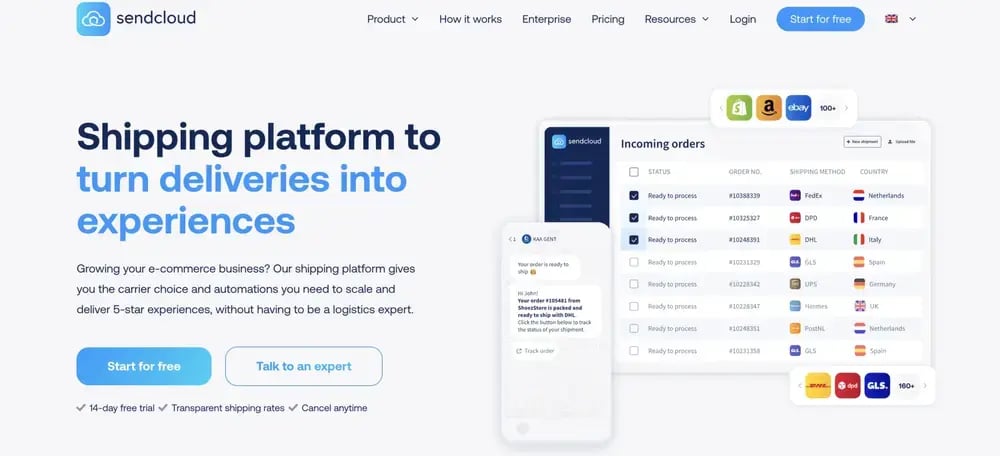
Sendcloud is shipping-first with serviceable post-purchase layers, and it's the right pick for European operations specifically. Its carrier network and service-point options are built around EU last-mile reality.
Key features
- Branded tracking and notifications
- Shipping automation rules (method selection, bulk actions, exception handling)
- Returns portal with self-serve label generation on paid tiers
- Dynamic checkout delivery options including service points and lockers
- Warehouse-friendly pack flows
Best for: Europe-focused brands needing multi-carrier shipping plus PPX visibility.
Integrations: Shopify, WooCommerce, Magento, PrestaShop, Lightspeed, Wix, Amazon, Odoo, multiple WMS tools.
Pricing: From €0, then €49/€99/€199 per month for Lite, Growth, and Premium.
Pros: Excellent EU carrier coverage and service-point support, strong shipping automation.
Cons: Returns portal is paid-tier only. International (non-EU) needs often require workarounds.
6. WeSupply Labs
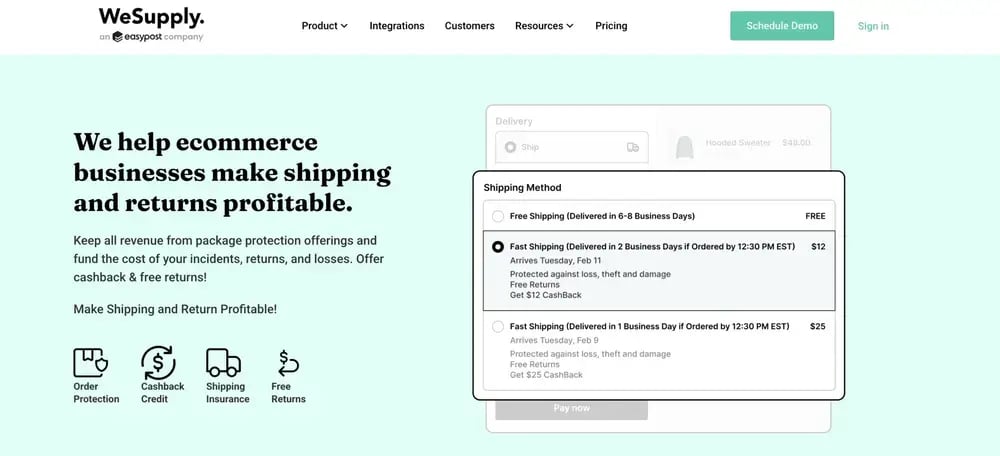
WeSupply Labs is a balanced tracking-plus-returns-plus-analytics platform with particular strength in omnichannel scenarios. BOPIS, BORIS, and click-and-collect flows are first-class rather than bolted on.
Key features
- Branded tracking pages with self-serve lookup
- Proactive status and exception notifications
- Returns and RMA portal with exchange-first defaults and label automation
- Carrier performance and return reason analytics
- Omnichannel BOPIS/BORIS support
Best for: Mid-market retailers with omnichannel complexity and high support volume.
Integrations: Shopify, Magento 2, BigCommerce, Salesforce Commerce Cloud, NetSuite; Zendesk, Klaviyo, Attentive; EasyPost.
Pricing: From around $60/month, mid-tiers from $168/month, enterprise custom.
Pros: Genuine balance of CX and operational analytics. Returns portal handles real workflows, not toy forms.
Cons: Entry pricing is steep for low-volume stores. Some carriers require indirect integration depending on region.
7. Outvio
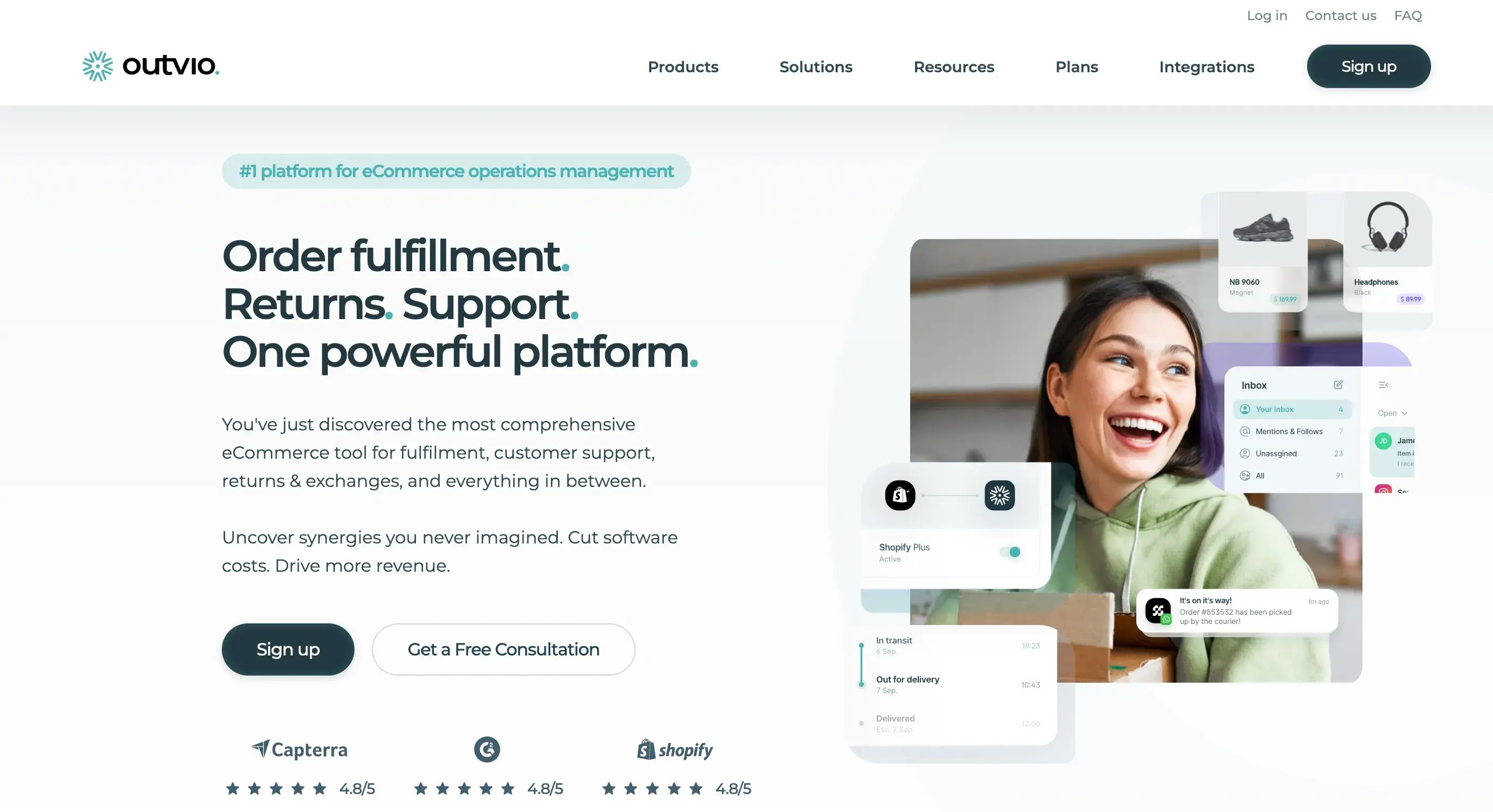
Outvio bundles shipping, tracking, returns, and a helpdesk-style support tool into one operational stack. It's built for operators who want fewer tools and tighter automation, not best-of-breed in any single category.
Key features
- Branded tracking pages with retention blocks
- Returns and exchanges portal with automated labels
- Multi-carrier label printing and shipping method automation
- Email, SMS, and WhatsApp notifications
- Built-in support workflows
Best for: High-volume operators consolidating their tool stack.
Integrations: Shopify, Shopify Plus, WooCommerce, PrestaShop, Magento, BigCommerce; 90+ carriers; Zendesk; API options.
Pricing: From around $125/month for mid-tier, $250/month+ for higher tiers, typically annualized.
Pros: Strong tool-consolidation play. Automation cuts operational drag fast. Branding is consistent across surfaces.
Cons: Limited trial access makes evaluation harder. Overkill if you only need branded tracking.
9. LateShipment
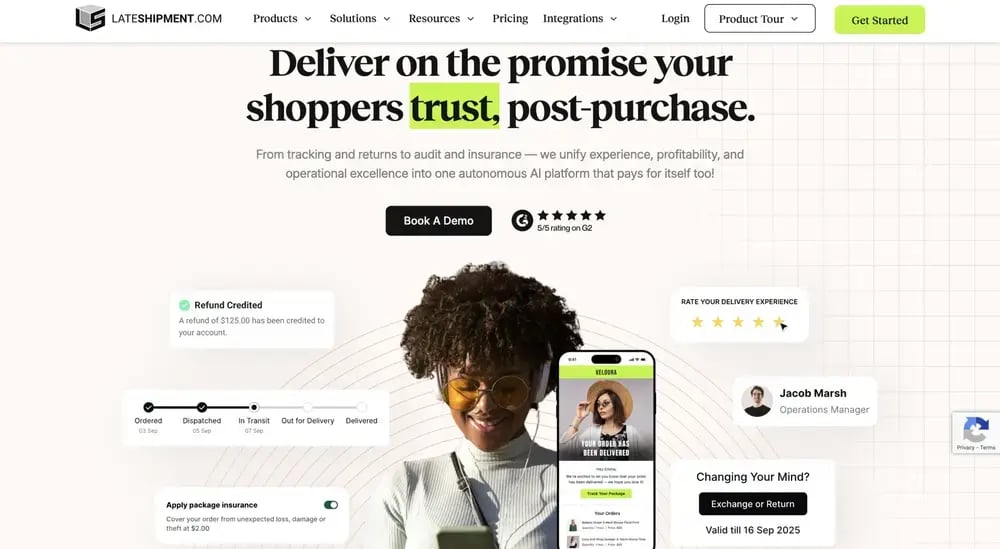
LateShipment combines standard PPX (tracking and returns) with a parcel audit and refund recovery engine. Carriers fail SLAs more often than most ops teams realize, and LateShipment recovers the credits automatically. For brands with significant carrier spend, the audit layer can fund the platform.
Key features
- Branded tracking and milestone notifications
- Predictive delay and exception alerts
- Returns portal with exchange-first workflows
- Shipping audit and refund recovery for carrier SLA failures
- Analytics tying exceptions to cost, not just CX
Best for: Brands and 3PLs that want WISMO deflection plus measurable shipping cost recovery.
Integrations: Shopify, Magento, BigCommerce, WooCommerce; Freshdesk, Salesforce, HubSpot; UPS, FedEx, DHL, USPS, and majors.
Pricing: From around $13/month per module, with bundle savings on combined products.
Pros: Audit recovery often pays for the platform. Strong exception comms. Modular pricing lets you start narrow.
Cons: Setup takes longer on older or heavily customized stacks. Exception signals can be noisy on certain lanes.
10. Parcel Perform
Parcel Perform positions itself as a delivery experience platform — data-first, enterprise-oriented, built around visibility, prediction, and operational intelligence. It's strongest for global operators who need consistent tracking and carrier performance data across regions.
Key features
- Branded multilingual tracking and notifications
- AI arrival predictions and exception detection
- Carrier performance dashboards and transit-time intelligence
- Returns portal options depending on configuration
- API, webhook, and structured data pipelines for enterprise BI
Best for: Enterprise brands, marketplaces, and 3PLs with global shipment volume.
Integrations: Shopify, Magento and Adobe Commerce, WooCommerce, BigCommerce, PrestaShop; Klaviyo; API, webhooks, CSV, SFTP.
Pricing: Custom, volume-driven.
Pros: Strong global carrier data reliability. Analytics built for ops, not just marketing dashboards.
Cons: Onboarding and data integration are heavier than SMB tools. Overbuilt if all you need is a branded tracking page.
5 Must-Have Features in a Post-Purchase Experience Platform (With Red Flags to Avoid)
A post-purchase platform is only as good as the controls it gives you. You are buying three things at once: customer-facing clarity, operational automation, and decision-quality data.
Here are the features that matter most.
1. Branded Tracking Pages: Turning Order Visibility Into a Retention Touchpoint
A branded tracking page keeps order visibility on your domain, with your tone, your support pathways, and your merchandising logic. It is where customers check status repeatedly, so it becomes a high-intent surface for reassurance and retention, not a dead end.
What to look for:
-
Domain mapping and full theming to ensure that the tracking experience matches your storefront design.
-
Support for split shipments and multiple tracking numbers per order, without confusing the customer.
-
Dynamic modules (FAQs, contact options, delivery instructions, reschedule prompts) that reduce tickets.
-
Post-purchase marketing blocks that are subtle (recommendations, replenishment reminders), not spammy.
Signals of a strong product:
-
The page explains what is happening in plain language, even when carrier scans are messy.
-
It can handle exceptions gracefully, not just “in transit” updates.
2. Proactive Multi-Channel Notifications: The Right Message at the Right Moment
The notification strategy is not “send more messages.” It is about sending the right message at the right moment, in the right channel, with the right escalation when something goes wrong. Platforms differentiate heavily here.
What to look for:
-
Multi-channel coverage: email alerts, transactional SMS, and sometimes WhatsApp, depending on region.
-
Milestone triggers (shipped, out for delivery, delivered) plus exception triggers (delay, failed attempt, held, address issue).
-
Cadence controls so customers are not bombarded, especially during scan-heavy legs of shipping.
-
Template flexibility that still preserves deliverability and clean formatting across devices.
Signals of a strong product:
-
It supports exception-first communication, not only happy-path milestones.
-
It gives ops teams rule controls without engineering dependence.
3. Self-Service Returns & Exchange Portal: Protecting Margin Without Hurting CX
Returns are where many brands leak margin. A good self-service portal turns a messy email thread into a guided workflow: eligibility checks, reason capture, label creation, exchange management, store credit incentives, and clear timelines. It should reduce friction for customers while protecting you from policy abuse.
What to look for:
-
RMA workflows with rule-based eligibility (window, condition, final sale, category exclusions).
-
Exchange-first options (variant exchanges, different-item exchanges, store credit bonuses).
-
Shipping label automation and drop-off options where relevant.
-
Reason and photo capture to improve quality control and reduce fraud on high-risk SKUs.
Signals of a strong product:
-
The portal feels well-branded and easy to use on mobile.
-
Exchanges are genuinely seamless, not a clunky workaround.
4. Post-Purchase Analytics: The KPIs That Tell You What's Really Happening
If you cannot measure post-purchase, you cannot improve it. The right analytics dashboard ties shipping outcomes to customer impact: delivery performance, exception rates, WISMO pressure, return reasons, and carrier performance patterns.
What to look for:
-
Carrier scorecards: on-time delivery, delay hotspots, exception frequency.
-
WISMO indicators: tracking page visits per shipment, contact deflection signals, “where is my order” drivers.
-
Returns analytics: reason codes, repeat returners, product-level patterns, and policy impact.
-
Export and API access for BI teams, if you are scaling.
Signals of a strong product:
-
It answers operational questions fast: “Which carrier lanes are hurting us?” “Which products drive returns?”
-
It supports action, not just charts.
5. Integrations & Scalability: Where "Looks Good in Demo" Breaks Down in Real Ops
The platform should plug into your stack without fragile workarounds. That is where “looks great in a demo” often breaks down in real operations, especially with multi-carrier support, 3PLs, and complex fulfilment setups.
What to look for:
-
Native Shopify support (and Shopify Plus readiness if relevant).
-
Broad multi-carrier support with clean carrier mapping and reliable event parsing.
-
Helpdesk integrations that let agents resolve exceptions within their existing workflow.
-
API integration quality: documentation, webhooks, and stability under volume.
Signals of a strong product:
-
Integrations feel maintained, not abandoned.
-
Your ops team can onboard carriers and workflows without weeks of technical dependency.
How to Choose a Post-Purchase Experience Platform: 7-Step Buyer's Framework
Picking a post-purchase experience platform is less about “features” and more about control: how fast you can detect delivery issues, how clearly you can communicate, and how reliably you can execute returns at scale. Use the steps below to narrow your shortlist based on real operating constraints, not shiny demos.
1. Step 1: Evaluating Notification Control — Channels, Triggers & Exception Playbooks
The fastest way to lose trust is silence or noise. The right platform lets you control which updates go out, when they go out, and what they say, across email, SMS, WhatsApp, and any other channels you actually use.
What to evaluate
-
Channel coverage by region: SMS may be essential in one market and optional in another.
-
Trigger depth: Milestones, delays, exceptions, failed delivery attempts, address issues, and “ready for pickup.”
-
Cadence controls: Frequency caps to prevent customers from spamming during carrier scan storms.
-
Template ownership: Editable templates with dynamic fields, brand voice, and localization.
-
Exception playbooks: Different messages for delay, loss, and damage, with clear next steps.
Questions to ask
-
Which events can we trigger on without custom engineering?
-
Can we suppress low-value updates and prioritize exception alerts?
-
Can we automatically route certain exceptions to support?
Red flags
-
“Omnichannel” that really means email and one SMS template.
-
No rate limits or scan de-duplication.
2. What a Truly Brandable Tracking Experience Looks Like (vs. Just a Logo Swap)
Your tracking page is a high-intent touchpoint. If it looks like a carrier site, you lose traffic, upsell opportunities, and control of the narrative when things go wrong.
What to evaluate
-
Domain mapping: Tracking on your domain, not a redirect.
-
Design flexibility: Layout control, content blocks, product recommendations, and FAQs.
-
Self-serve depth: Order lookup, shipment split visibility, and clear status explanations.
-
Localization: Multi-language, local time formats, and region-specific messaging.
Questions to ask
-
Can we show split shipments and multiple tracking numbers cleanly?
-
Can we embed support options and deflect WISMO without hiding escalation paths?
Red flags
-
“Branded” page that only supports a logo swap.
-
Weak handling of partial fulfillments.
3. Returns & Exchange Workflow Depth — Where Margin Is Won or Lost
Returns are where margin goes to die, or loyalty gets built. A strong platform gives you rule-based control while still feeling effortless for the shopper.
What to evaluate
-
Policy rule engine: Eligibility by SKU, category, price, reason, and time window.
-
Resolution prioritization: Exchange-first, store credit incentives, instant exchanges.
-
RMA workflows: Approvals, label generation, drop-off options, and status updates.
-
Fraud controls: Abuse detection, blocklists, photo/video verification where needed.
Questions to ask
-
Can we nudge exchange/store credit without making refunds feel punitive?
-
Can we support returnless resolutions for low-value items?
Red flags
-
Exchanges limited to same-variant swaps only.
-
No clean workflow for damaged-in-transit vs. buyer’s remorse.
4. Analytics That Drive Decisions, Not Just Charts
You cannot improve what you cannot measure. Your platform should convert shipment and return activity into usable operational signals, not vanity dashboards.
What to evaluate
-
Carrier scorecards: On-time rate, delay reasons, scan quality, exception frequency.
-
WISMO measurement: Ticket deflection signals and contact rate by shipment stage.
-
Returns analytics: Reason codes, product-level patterns, and cost-to-serve.
-
Segmentation: By region, carrier, warehouse, product line, and customer cohort.
Questions to ask
-
Can we isolate which carriers or lanes drive the most contacts?
-
Can we tie post-purchase changes to retention or repeat purchase behavior?
Red flags
-
Reports you cannot export or automate.
-
Metrics that are not definable, auditable, or consistent.
5. Integration & Scalability Testing — What Breaks at 2× Volume?
Most platforms look fine in a trial. The pain shows up when you add multiple warehouses, carriers, marketplaces, and support tooling.
What to evaluate
-
E-commerce integrations: Shopify, Shopify Plus, Magento/Adobe Commerce, BigCommerce, etc.
-
Support stack: Gorgias/Zendesk/Service Cloud, plus routing for exceptions.
-
Carrier connectivity: Breadth is good, but reliability and scan normalization matter more.
-
API robustness: Webhooks, retry logic, rate limits, and clear documentation.
Questions to ask
-
What breaks first when we double the order volume?
-
Can we add a new carrier or 3PL without weeks of custom work?
Red flags
-
“We have an API,” but no webhooks, no clear error handling, and no sandbox.
6. Pricing Models & Total Cost of Ownership (The Hidden Fees to Watch)
Post-purchase pricing is rarely apples-to-apples. Some tools charge per shipment, some per return, some per module, and implementation can be the hidden cost.
What to evaluate
-
Pricing model clarity: Subscription vs. per-transaction fees vs. bundles.
-
Module gating: Whether core needs (custom domain, SMS, returns) require upgrades.
-
Implementation realities: Setup time, internal engineering, and ongoing admin overhead.
-
ROI logic: Ticket reduction, retention lift, fewer refunds via exchanges, fewer carrier penalties.
Questions to ask
-
What will our cost be at 2× volume, not today’s volume?
-
Which features are truly included, and which are add-ons?
Red flags
-
Vague “custom pricing” with no reference ranges.
-
Critical features that are locked behind multiple upgrades.
How to Measure Post-Purchase ROI?
A post-purchase platform should pay for itself two ways: fewer support contacts and higher retention. Track both, or you'll underestimate the impact.
The 8 KPIs Every Operations Team Should Track
-
WISMO contact rate — WISMO tickets per 100 orders, segmented by carrier and lane
-
Cost-to-serve — support cost per order, before and after rollout
-
Repeat purchase rate — share of customers reordering within 60, 90, or 180 days
-
Customer lifetime value — cohort-based CLV change after PPX rollout
-
Delivery exception rate — delays, failed attempts, loss/damage claims per 100 shipments
-
Return resolution mix — refund versus exchange versus store credit, plus retained revenue
-
Return cycle time — days from request to resolution
-
CSAT and CES on tracking and returns — effort scores predict churn better than satisfaction
A Working ROI Calculator
Gains:
- WISMO tickets reduced × cost per ticket
- Incremental repeat purchases × contribution margin
- Refund-to-exchange shift × margin preserved
- Carrier audit recoveries (where applicable)
Costs:
- Subscription and per-transaction fees
- Implementation and integration effort
- Ongoing admin time and SMS or messaging fees
Benchmark four weeks before launch. Compare 8–12 weeks after, by cohort, not by aggregate. If the numbers move, expand. If they don't, the issue is almost always configuration, not the platform.
FAQs
What is the post-purchase experience?
Everything after checkout: confirmation, tracking, delivery updates, unboxing, support, returns, and re-engagement. It shapes brand trust more than the product page does.
Why is post-purchase experience important?
It directly drives repeat purchase rate and support cost. When customers can't see what's happening, they either contact support or churn. Both are expensive.
What does a post-purchase platform do?
It centralizes tracking, automates branded notifications, manages returns and exchanges through self-service workflows, and reports on delivery performance and customer behavior in one system.
Is an order tracking app the same as a post-purchase platform?
No. Tracking apps focus on visibility and notifications. Full PPX platforms add returns, exception handling, analytics, carrier orchestration, and deeper integrations.
Which teams own this stack?
Usually CX and operations co-own it. CX cares about messaging and ticket deflection. Operations cares about exceptions, carrier performance, and cost.
How long does implementation take?
SMB tools can go live in days. Enterprise platforms take 8–12 weeks when you include workflow design, data mapping, and multi-warehouse complexity.
What's the difference between a shipping platform and a post-purchase platform?
A shipping platform handles pre-dispatch — carrier allocation, label generation, manifest. A post-purchase platform handles post-dispatch — tracking, notifications, exceptions, returns. Platforms like ClickPost cover both, which is why they typically replace stacks of two or three single-point tools.
The Takeaway
Post-purchase isn't a CX layer you bolt on. It's where retention either compounds or quietly leaks, and where the brands winning in 2026 are treating it like core infrastructure. The best platforms keep customers informed without noise, surface exceptions early enough to act, and make returns feel effortless while protecting margin through exchange-first defaults.
Start by mapping your post-checkout journey end to end. Shortlist two or three platforms that match your actual complexity — carriers, regions, split shipments, returns volume, NDR exposure. Run a pilot on a defined cohort. Measure WISMO contact rate, exception rate, repeat purchase rate, return mix, and cycle time. If the numbers move, expand. If they don't, look at configuration before you blame the platform.
For brands shipping at scale across multi-carrier networks — particularly where NDR, RTO, and exception handling are material cost lines — a shipping-led platform like ClickPost will outperform a CX-only PPX layer because the underlying carrier data is the bottleneck, not the email template.