%20%20-%20Menu.svg)




.png?width=879&height=549&name=Page%2074%20(1).png)



In this blog
TL;DR – The Best Reverse Logistics Software Alternatives in 2026
Reverse logistics now spans authorization, routing, inspection, disposition, and reporting — but no single platform dominates every use case, making the right fit critical.
- ClickPost – Best for high-volume e-commerce carrier complexity
-
Narvar – Best for enterprise omnichannel retail at scale
-
Outvio – Best for high-growth cross-border e-commerce ops
-
ReverseLogix – Best for complex RMA-to-disposition return lifecycles
-
Locus – Best for enterprise reverse pickup route optimization
-
revers.io – Best for EU retail with repair and second-life flows
-
ReturnGO – Best for Shopify brands prioritizing exchanges over refunds
-
nShift – Best for e-commerce and 3PL multi-carrier returns
-
ReBound – Best for enterprise managed cross-border returns
Why Reverse Logistics Software Is Now a Business-Critical Investment in 2026
Returns are no longer a side process. They are a parallel supply chain with its own cost structure, customer expectations, fraud risks, and sustainability pressure. Research shows that the global reverse logistics market reached USD 711 billion in 2025. And for e-commerce, return rates can reach ~30%, compared to single-digit rates in physical stores. That is why manual, inbox-driven return handling quickly collapses as volume grows.
That is where Reverse Logistics Software earns its keep. It replaces ad hoc steps (emails, spreadsheets, carrier portals, siloed warehouse decisions) with a controlled system. This system involves a returns portal, an RMA engine, tracking, disposition rules, warehouse workflows, and analytics that explain why returns happen and where money leaks. It also protects the customer experience, which is non-negotiable. Data shows that 84% of consumers say they will not shop again after a poor returns experience.
This guide is for supply chain managers, e-commerce operations leaders, and logistics decision-makers who need a practical view of what reverse logistics software does, why it matters, and what to look for before evaluating vendors. We focus on the mechanics that move the needle. Some examples are faster approvals, fewer tickets, better disposition, tighter inventory recovery, and lower per-return cost.
Key Stats & Highlights: Why Reverse Logistics Software Matters in 2026
-
Scale is the point: Returns are now a material operational load, not an exception. In 2023 alone, U.S. retail returns were estimated at $743 billion.
-
E-commerce amplifies friction: Online return rates can reach ~30%, far higher than physical retail, pushing teams toward automation.
-
Customer experience is fragile: A bad returns process can permanently damage repeat-purchase behavior.
-
Sustainability is not optional: Consumers are increasingly willing to pay more for sustainably produced goods, making "green" return options and waste reduction part of the business case.
-
The market is expanding: Reverse logistics is now a recognized growth category within the broader logistics software ecosystem.
What Is Reverse Logistics Software and How Does It Work?
Reverse logistics software is the system that manages product movement backward through your network after a sale. That includes returns, exchanges, warranty claims, repairs, refurbishments, replacements, recycling, and resale. Unlike forward logistics, reverse flow is messy. Items come back in unpredictable condition, with inconsistent packaging, incomplete data, and a higher risk of fraud and disputes. Software brings structure to that chaos.
At its core, this category acts like a "returns operating system." It connects customer-facing experiences (returns portal, tracking updates, refunds/exchanges) with internal execution (warehouse receiving, inspection, disposition, inventory recovery, finance settlement). Instead of every return being a one-off case handled by support teams and warehouse supervisors, returns become a repeatable workflow with rules, controls, and measurable outcomes.
Core Components of a Reverse Logistics Platform
Let us look at the various key components of Reverse Logistics Software.
1. Returns portal and eligibility checks
A self-service entry point where customers initiate requests, upload proof (when needed), and select resolution options. The portal enforces policy automatically (window, condition, category exclusions).
2. RMA management and workflow orchestration
A structured return merchandise authorization flow in the given order: request → approval → label/pickup → in-transit tracking → receiving → inspection → disposition → refund/exchange/store credit.
3. Carrier integrations and returns tracking
Automatic label creation, pickup scheduling, QR/printless flows, and tracking visibility that prevents "Where is my return?" ticket spikes.
4. Disposition and value recovery engine
Rules that determine what happens after inspection: restock, refurbish, route to repair, return to vendor, recycle, donate, or send to recommerce channels.
5. Inventory and finance synchronization
Restocking and availability updates, refund triggers, store credit issuance, fee deductions, and audit trails that keep accounting clean.
6. Analytics and exception management
Dashboards for return reasons, SKU/size issues, carrier performance, cycle time, fraud signals, recovery rate, and cost per return, plus workflows for exceptions (lost, damaged, wrong item).
5 Reasons Your E-Commerce Business Needs Reverse Logistics Software
Without software, returns become a tax on growth. Every return pulls time from support, warehouse, finance, and sometimes merchandising. It also creates invisible costs due to delayed restocks, inconsistent decisions, fraud-related leakage, and avoidable refunds that would have retained revenue.
Reverse logistics software creates leverage by standardizing decisions and automating repeatable work. It does not "make returns free," but it makes them controllable.
1. How reverse logistics software reduces operational and shipping costs
Returns are expensive because they are labor-heavy and exception-heavy. Software reduces touches per return by automating approvals, label generation, customer updates, and routing rules. It also prevents avoidable shipping spend via smarter choices, such as consolidated returns, localized drop-off options, or "keep item" resolutions for low-value products where reverse shipping costs exceed recovery value.
2. How automated returns improve customer experience and reduce support tickets
Customers do not want to email support to ask how returns work. They want clarity, speed, and visibility. A self-service flow reduces friction and keeps the customer informed, which directly reduces inbound "WISMO/WISMR" tickets. The loyalty impact is real. Poor return experiences are strongly associated with churn and lost repeat purchases.
3. Sustainability and compliance improvements in returns management
Returns create waste, involving packaging, transport emissions, and unsellable goods. Modern reverse logistics software supports greener outcomes through paperless labels, drop-off consolidation, donation/recycling routing, and faster disposition to prevent unnecessary landfill. It matters because consumers increasingly reward sustainable practices with a willingness to pay a premium.
4. Maximizing value recovery and building a recommerce strategy
The fastest way to lose money on returns is slow processing. Delay reduces resale value, increases write-offs, and forces markdowns. Software improves recovery by accelerating inspection and routing items to the most profitable path. Some actions are restock, refurbish, repair, parts harvesting, or resale. It also helps you build a defensible recommerce strategy by tracking item condition and creating structured resale inventory.
5. Using returns data for executive visibility and continuous improvement
Returns data is product truth. If you cannot reliably see return reasons by SKU, size, region, and carrier, you cannot fix the underlying issues (bad sizing charts, misleading photos, fragile packaging, poor carrier lanes). Reverse logistics software turns returns into a measurable feedback loop that improves product, operations, and customer lifecycle performance.
7 Key Features to Look for in Reverse Logistics Software: 2026 Buyer Checklist
Reverse logistics tools often look similar in demos. The difference shows up in the mechanics: rule depth, workflow control, integration quality, and whether the system can handle exceptions without human firefighting. These are the features that matter most.
1. Branded self-service returns portal: what to look for
The portal is where policy becomes reality. A clear, branded portal reduces tickets, builds trust, and prevents policy abuse because customers cannot "talk their way around" rules.
What to look for:
-
Multiple lookup methods (order number, email, phone, OTP) to match your market and reduce failed lookups.
-
Resolution choices (refund, exchange, store credit) that are presented with smart defaults and incentives.
-
Guided reason capture with structured reason codes, photo/video upload when relevant, and conditional follow-ups.
-
Explicit policy messaging (fees, final sale, condition rules) without burying the customer in legal text.
-
Mobile-first experience because most customers initiate returns on mobile.
2. RMA management and workflow automation: the operational backbone
RMA workflows determine speed, accuracy, and cost. If your team still approves each return manually, you will hit a ceiling.
What to look for:
-
Automated approvals/rejections based on window, SKU, order value, customer segment, and reason codes.
-
Configurable stages (requested, approved, shipped back, received, inspected, resolved) with audit trails.
-
Exception workflows for "no movement," "lost return," "wrong item," "damaged," and "late drop-off."
-
SLA controls (auto-escalation, reminders, aging dashboards) to reduce stalled cases.
3. Rules engine and returns policy controls for margin protection
Returns policies are not one-size-fits-all. Your rules need to reflect margin, fraud risk, product type, and seasonality.
What to look for:
-
Eligibility rules by SKU/category (for hygiene items, final sale, bundles, hazardous goods).
-
Dynamic fees (restocking fees, label deductions) with transparent customer communication.
-
Customer segmentation (loyal customers vs. repeat returners) with different approval paths.
-
Returnless options for low-value items where shipping back is irrational.
-
Exchange-first logic with credit bonuses or instant exchange options where appropriate.
4. Multi-carrier integrations and returns tracking: eliminating visibility gaps
Returns often fail in the handoff between "approved" and "in transit." Tracking closes that gap and reduces support load.
What to look for:
-
Label generation automation (prepaid, customer-paid, or hybrid) with rate-shopping if you operate at scale.
-
Pickup and drop-off options, including QR codes/printless flows where supported.
-
Multi-carrier support with reliable status mapping and exception alerts.
-
Customer notifications that reduce inbound tickets without spamming.
5. WMS and ERP integration for inventory recovery and financial accuracy
The highest hidden cost in returns is the distortion of inventory and the delay in recovery. If restocks lag, you lose sales; if finance data is messy, you create disputes.
What to look for:
-
Real-time inventory updates at the right node (warehouse, store, 3PL) after inspection, not just "received."
-
Disposition-driven routing (restock vs. refurb vs. scrap) feeding WMS actions.
-
Refund triggers tied to inspection outcomes and policy rules (not manual spreadsheet approvals).
-
APIs/webhooks that let you integrate deeply instead of relying only on "native connectors."
6. Returns analytics dashboard: how to prove ROI and drive continuous improvement
If you cannot measure returns properly, you cannot reduce them or recover value.
What to look for:
-
Return reasons by SKU/variant (size issues, quality defects, misleading description) with trend views.
-
Cycle time metrics (request-to-resolution, warehouse processing time, refund time).
-
Recovery rate metrics (percent restocked, refurbished, resold, written off).
-
Fraud and abuse signals (return frequency, mismatch patterns, high-risk reasons).
-
Carrier and lane insights for damage rates and delay-driven returns.
7. Omnichannel returns support: handling buy-online-return-in-store and marketplace flows
Omnichannel returns are where policy breaks first. Customers buy online and want to return in-store, or buy through marketplaces with different rules.
What to look for:
- BORIS support (buy online, return in store) with clean handoffs to POS/store inventory.
- Marketplace-aware workflows if you sell on multiple channels.
- Multi-location routing so returns go to the right node for the fastest resale.
Top 10 Reverse Logistics Software Platforms for 2026: Expert Comparison
Reverse logistics is no longer just about getting a package back. At scale, it is a controlled workflow that includes authorization, pickup, routing, inspection, disposition, resale, refund, and reporting. The platforms below cover that workflow in different ways, from enterprise-grade returns networks to RMA rule engines and reverse pickup orchestration.
Comparison Table (Key features, Pricing, Rating)
|
Platform |
Key features |
Best for |
Pricing (starting point) |
Integrations |
G2 rating |
|
Portal, routing, boxless returns, fraud controls, analytics |
Enterprise omnichannel retail |
~$30,000–$45,000+/year (quote-based) |
Shopify, Magento, SFCC; SAP/Oracle; Zendesk/Klaviyo |
||
|
Shipping + returns automation, portals, and incidents |
High-growth e-commerce, cross-border ops |
€29/month; ~ $4,500/year for full suite |
Shopify/WooCommerce/etc, 100+ carriers; API |
||
|
Returns portal, automation, carrier allocation, RTO prevention |
High-volume e-commerce + carrier complexity |
~$300 per feature/month (quote-based) |
Shopify/WooCommerce/Magento; 500+ carriers; WMS/OMS |
||
|
RMS lifecycle: RMA → repair → disposition |
Mid-market/enterprise with complex returns |
$2,000–$6,000+/month (quote-based) |
Shopify/Salesforce; SAP/NetSuite; APIs |
||
|
Reverse pickup routing + control tower |
Enterprise reverse pickup optimization |
$2,500–$10,000+/month (quote-based) |
API-first; ERP/WMS/OMS; telematics |
||
|
Omnichannel returns + repairs + second-life flows |
EU-heavy enterprise retail/manufacturing |
~€1,000/month |
SAP/Salesforce/Dynamics; EU carrier network; APIs |
||
|
Exchange-first returns portal + rules engine |
Shopify brands, exchange-heavy categories |
$23/month |
Shopify + major apps; helpdesk; shipping tools |
||
|
Multi-carrier returns + automation + scan tools |
E-commerce + 3PL return handling |
€8/month |
Shopify/Magento; SAP/Dynamics; carriers |
||
|
Managed omnichannel returns + hubs + carriers |
Enterprise cross-border returns |
Quote-based (not public) |
Shopify alignment; 300+ carriers; regional hubs |
— |
Editorial disclosure & methodology (2026)
This list is built for operators who live in exceptions, not for keyword coverage. The goal is practical fit. It answers what works when return volume, carrier complexity, and policy edge cases become everyday work.
How we shortlisted tools
-
Evaluated reverse logistics depth: RMA workflows, routing, inspection, and disposition support
-
Looked for automation that reduces manual handling (approvals, labels, scan-triggered actions)
-
Checked integration reality: e-commerce platforms, WMS/ERP connectivity, APIs, and partner ecosystems
-
Compared pricing models by operating stage (SMB vs. mid-market vs. enterprise), including onboarding overhead
-
Stress-tested claims against real scenarios: split shipments, cross-border returns, multi-warehouse routing, and fraud abuse patterns
1. Narvar: Best Reverse Logistics Software for Enterprise Omnichannel Retail
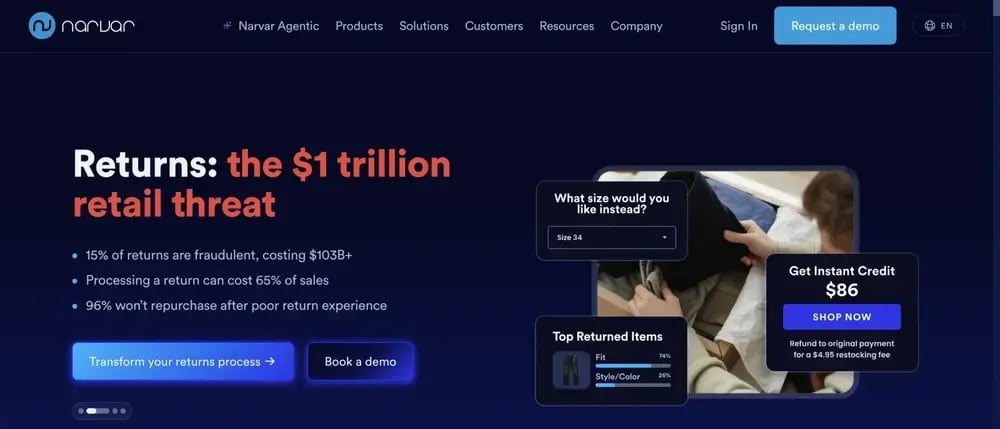
Narvar is an enterprise-grade post-purchase platform and reverse logistics solution built for high-volume, omnichannel retailers. It pairs a branded returns experience with automation behind the scenes, including multi-destination routing and fraud controls. Narvar scales well for brands dealing with complex assortments, store networks, and large return volumes, but it is usually too heavy and costly for smaller operators. If you are evaluating alternatives, see our Narvar alternatives comparison.
Key features
-
A branded self-service returns portal that reduces support load.
-
Intelligent routing to warehouses, stores, or vendors based on rules and cost.
-
Boxless, label-free drop-offs through large partner networks.
-
Fraud prevention (policy abuse detection) and delivery claims support.
-
Instant exchange/store credit triggers to retain revenue.
-
Returns analytics for reasons, velocity, and performance.
Best for
-
Enterprise and omnichannel retailers with complex return logic.
-
Apparel, electronics, and categories with high return rates.
-
Teams that need CX + policy enforcement + fraud controls.
Integrations
-
E-commerce/OMS: Shopify, Magento, Salesforce Commerce Cloud, BigCommerce
-
ERP/WMS: SAP, Oracle, Bluecherry, Unicommerce
-
CX/marketing: Zendesk, Klaviyo
-
Carriers: Deep carrier integrations for automated labels
Pricing (2026): Quote-based annual contracts. Typical starting range is $30,000–$45,000+ per year (basic setup; increases with modules and volume)
Pros
-
Strong enterprise return routing and policy logic for complex networks.
-
High CX impact (clean portals + proactive workflows).
-
Mature fraud and abuse controls for margin protection.
Cons
-
High entry cost and longer implementation timelines.
-
Not a fit for low-volume brands that want a quick, lightweight setup.
2. Outvio: Best All-in-One Returns and Shipping Automation for Growing E-Commerce Brands
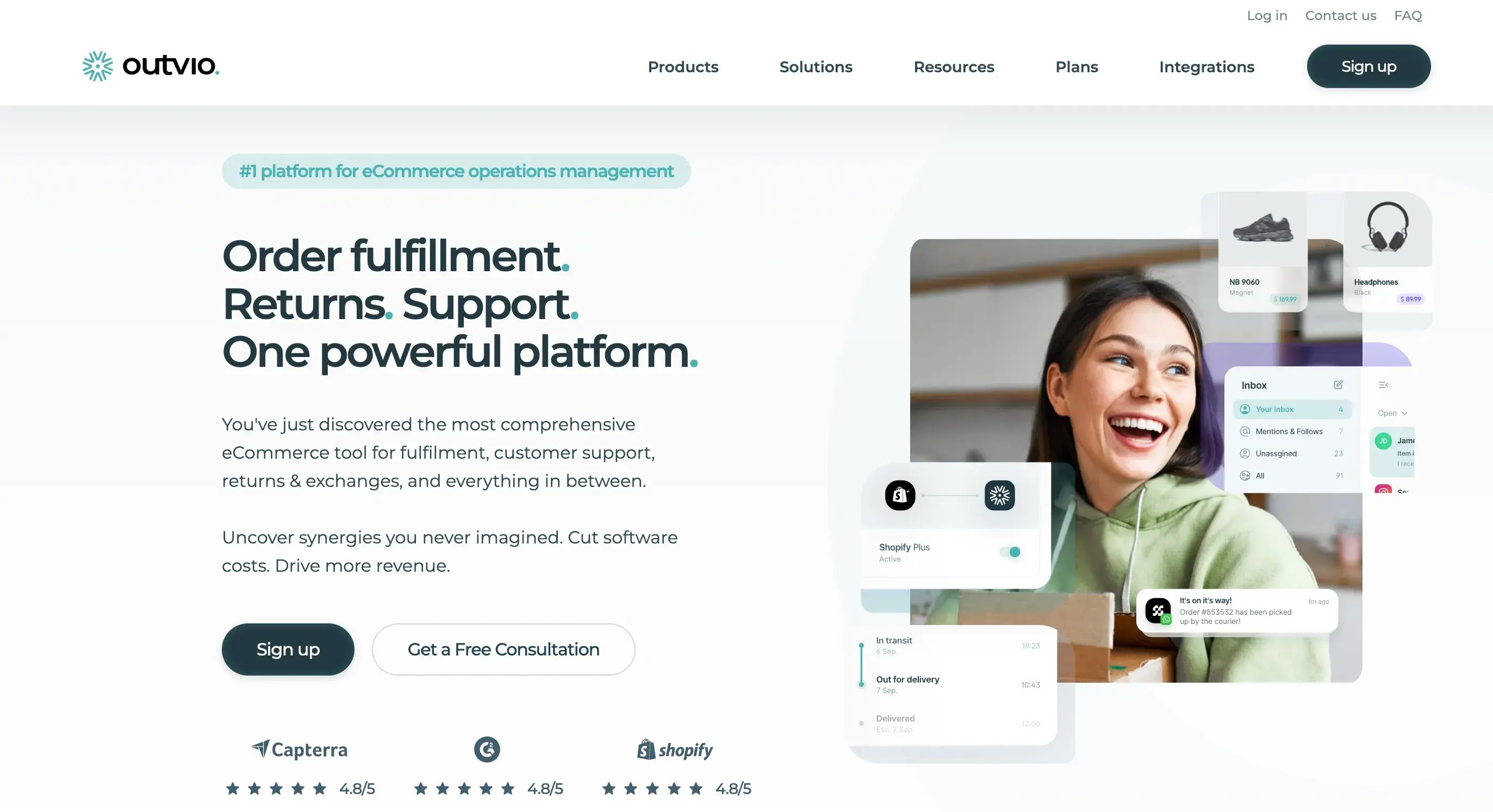
Outvio is a "control tower" style platform that combines shipping, branded tracking, returns/exchanges, exception management, and e-commerce automation in one system. It is designed to scale with multi-carrier and multi-warehouse operations, especially for brands that want fewer tools and more workflow automation across post-sale operations.
Key features
-
Fully automated returns and exchanges with configurable approvals.
-
Branded returns portal + customer updates across channels.
-
Multi-carrier label generation and smart carrier selection.
-
Incident/exception manager for delivery and operational issues.
-
Revenue-focused return flows (upgrade exchanges, store credit paths).
-
Optional carrier invoice auditing to recover costs.
Best for
-
High-growth e-commerce brands scaling cross-border operations.
-
Teams looking for one platform for shipping, returns, and post-sale automation.
-
Operators who are trying to reduce manual work across support and ops.
Integrations
-
Shopify/Shopify Plus, WooCommerce, PrestaShop, Shopware, Magento, BigCommerce, Wix
-
100+ carriers (DHL, UPS, FedEx, DPD, GLS, others)
-
Open API for custom integrations
Pricing
- Starting price: €29/month (entry tier)
- Typical "full-suite" starting point: ~$4,500/year for higher automation packages
- Free trial: available
Pros
-
Broad automation depth across returns, shipping, and exceptions.
-
Strong branded experience without heavy IT involvement.
-
Reduces tool sprawl (fewer disconnected systems).
Cons
-
It can be expensive for very small brands when configured to the fullest.
-
Feature-rich UI can take time to operationalize correctly.
3. ClickPost: Best Reverse Logistics Software for High-Volume E-Commerce with Complex Carrier Networks
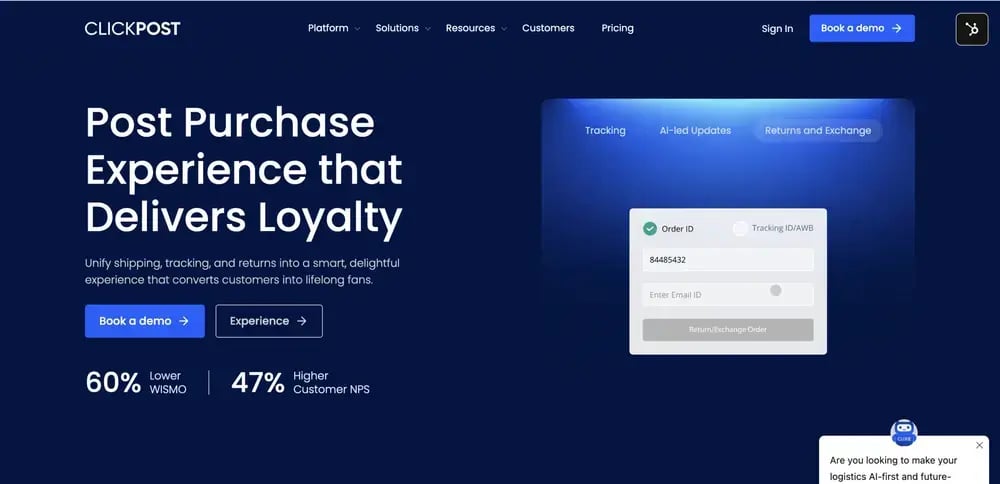
ClickPost is a logistics intelligence platform that also supports reverse logistics through automated returns, carrier allocation, and analytics. It is particularly strong for high-volume e-commerce operations that care about delivery success, Return to Origin prevention, and tightly managed courier performance. It scales from growth-stage brands to large operators by integrating with WMS/OMS/ERP layers.
Key features
-
Branded self-service returns portal for returns/exchanges/store credit.
-
Automated return authorization, pickup scheduling, and label generation.
-
Multi-carrier allocation (500+ partners) for cost and service optimization.
-
Reverse logistics analytics for return reasons and product/vendor patterns.
-
Exchange-first flows to retain revenue.
-
AI-driven NDR/RTO prevention workflows (including voice/SMS/WhatsApp support).
Best for
-
Brands with high return volumes and multi-carrier complexity.
-
Operators focused on reducing RTO and tightening courier performance.
-
Omnichannel teams coordinating returns across nodes.
Integrations
- Platforms: Shopify, WooCommerce, Magento, other storefronts
- Carriers: 500+ partners (varies by region)
- Ops tools: WMS/OMS/ERP connectivity + marketing/support tools (example: HubSpot)
Pricing
- Quote-based
Pros
-
Strong carrier network and allocation logic for cost control.
-
Good visibility across forward + reverse performance.
-
Automation reduces manual handling and improves return cycle speed.
Cons:
-
Better suited to established operations; can feel "too much" for micro-sellers.
-
Testing is harder without a standard free trial path.
4. ReverseLogix: Best Purpose-Built Returns Management System for Mid-Market and Enterprise
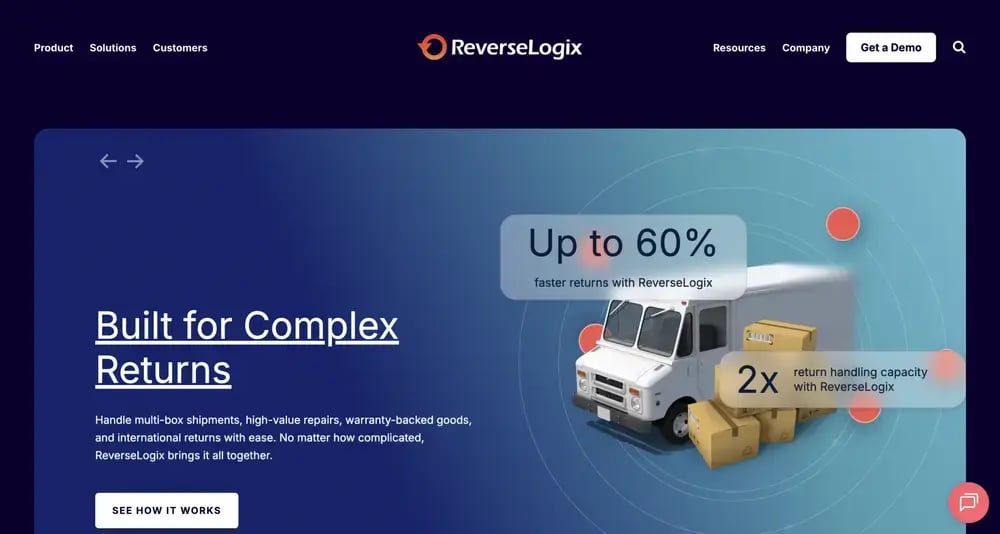
ReverseLogix is a purpose-built returns management system that covers the full reverse lifecycle. It includes RMA, warehouse processing, inspection, repairs/refurbishment, and disposition. It is built for complex workflows and scales well across high transaction volumes, multiple facilities, and B2B + B2C environments.
Key features
-
Branded portal for RMA initiation, labels, and return status.
-
Return policy engine and rule-based approvals/refund handling.
-
Warehouse receiving, inspection, grading, and routing workflows.
-
Repairs/refurbishment management with parts and warranty tracking.
-
Fraud detection and analytics on return reasons and losses.
-
Recommerce support (move eligible items into resale flows quickly).
Best for
-
Mid-market and enterprise brands with complex return processing.
-
Manufacturers and retailers handling serialized or warranty-heavy products.
-
3PLs managing returns on behalf of brands.
Integrations
-
Shopify, Salesforce, Magento, WooCommerce
-
SAP, Oracle NetSuite, Manhattan, Blue Yonder
-
Carrier connectors (example: FedEx, Pitney Bowes) + API-first approach
Pricing: Quote-based enterprise SaaS. Typical entry reality: $2,000–$6,000+/month depending on modules, volume, and integrations (implementation costs may apply)
Pros
-
True end-to-end reverse workflow control beyond "just a portal."
-
Highly configurable rule logic for complex environments.
-
Strong warehouse and disposition depth for value recovery.
Cons
-
Heavier implementation and training requirements.
-
Pricing is not transparent; it needs sales-led scoping.
5. Locus: Best Reverse Logistics Software for Enterprise Pickup Route Optimization
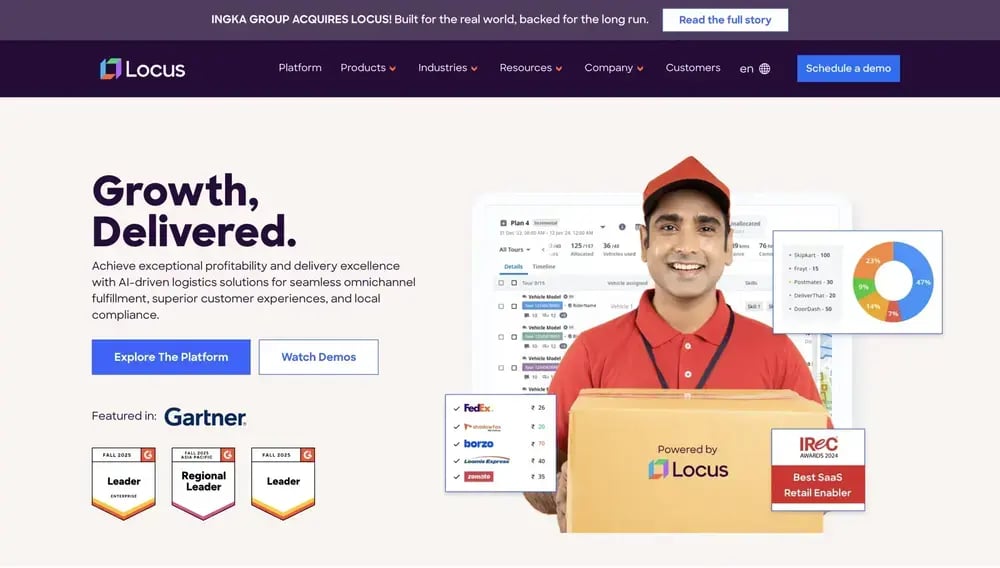
Locus is a logistics route optimization platform that can optimize reverse pickups, fleet utilization, and visibility. It is the "reverse movement optimizer" in your stack that offers route planning, control tower visibility, and execution management for return pickups and inbound flow. It scales for enterprise-grade networks and peak surges.
Key features
-
Reverse pickup routing optimization to reduce drive time and cost.
-
Control tower visibility for delays, exceptions, and service adherence.
-
Workflow automation for authorization, inspection, and sorting handoffs.
-
Unified management of owned fleets, partners, and 3PLs.
-
Address intelligence/geocoding to reduce failed pickups.
-
Driver app support for execution updates and proof of pickup/delivery.
Best for
-
Large enterprises with high return pickup density.
-
3PLs coordinating reverse collections across geographies.
-
Brands where reverse transport cost is the biggest lever.
Integrations
-
API-first; connects to SAP/Oracle and common WMS/OMS layers
-
Telematics and driver app execution stack integration
Pricing (2026): Quote-based enterprise subscription. Typical starting range: $2,500–$10,000+/month depending on fleet size, transactions, and modules.
Pros
-
Strong cost impact for reverse pickups through routing efficiency.
-
High visibility across execution and exceptions.
-
Scales well across large, distributed operations.
Cons
-
Change management and operational adoption are required.
-
Often over-engineered for SMBs that mainly need a returns portal.
6. revers.io: Best Reverse Logistics Platform for EU Enterprise Retail and After-Sales Repair Workflows
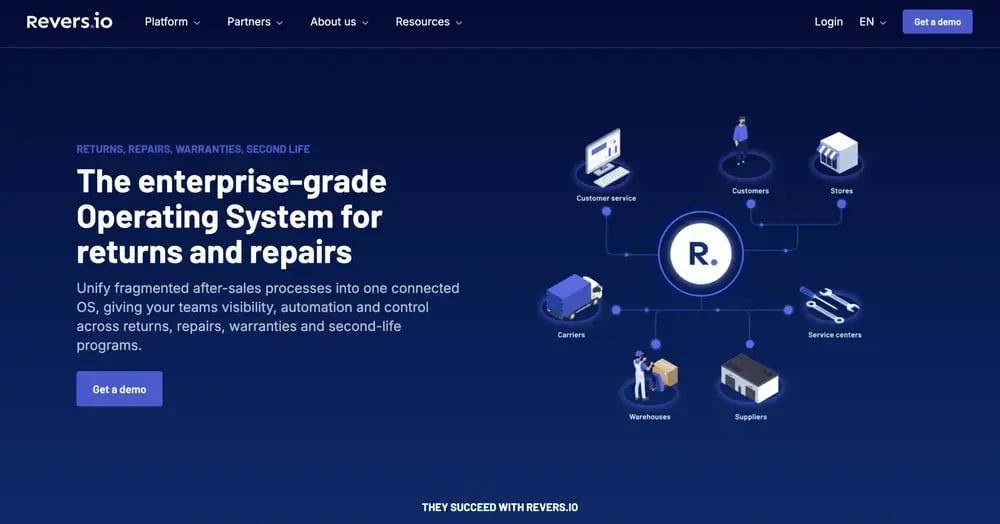
revers.io is an omnichannel reverse logistics platform widely used in Europe, covering returns, repairs, and after-sales workflows. It connects brands to logistics providers, repairers, warehouses, and partners through configurable workflows. It scales for enterprise volumes and multi-country operations, especially when repair and after-sales complexity is high.
Key features
-
Omnichannel return portal (branded, self-service).
-
Workflow engine for returns/exchanges/refunds without heavy coding.
-
Repair and spare parts management for service-based returns.
-
Warehouse receiving, inspection, grading, and routing automation.
-
"Second-life" flows for reconditioning and resale readiness.
-
Control tower reporting across partners and SLA performance.
Best for
-
Retailers with high-volume omnichannel returns.
-
Manufacturers handling repairs, service, and warranty operations.
-
Multi-country operators that need structured partner workflows.
Integrations
-
Carriers: DHL, DPD, Chronopost, Colissimo, GLS, UPS, others
-
ERP/CRM: SAP Commerce Cloud, Salesforce, Microsoft Dynamics, Zendesk
-
Custom APIs + connectors for partner networks
Pricing (2026): Subscription-based. Reported starting point: ~€1,000/month (scales with volume and modules).
Pros
-
Strong repair and after-sales workflow depth.
-
Great partner coordination for complex return ecosystems.
-
Enterprise-grade traceability and multi-country readiness.
Cons
-
Higher entry cost than plug-and-play returns apps.
-
Some ERP integrations can be complex during onboarding.
7. ReturnGO: Best for Shopify Brands With Exchange-Heavy Categories
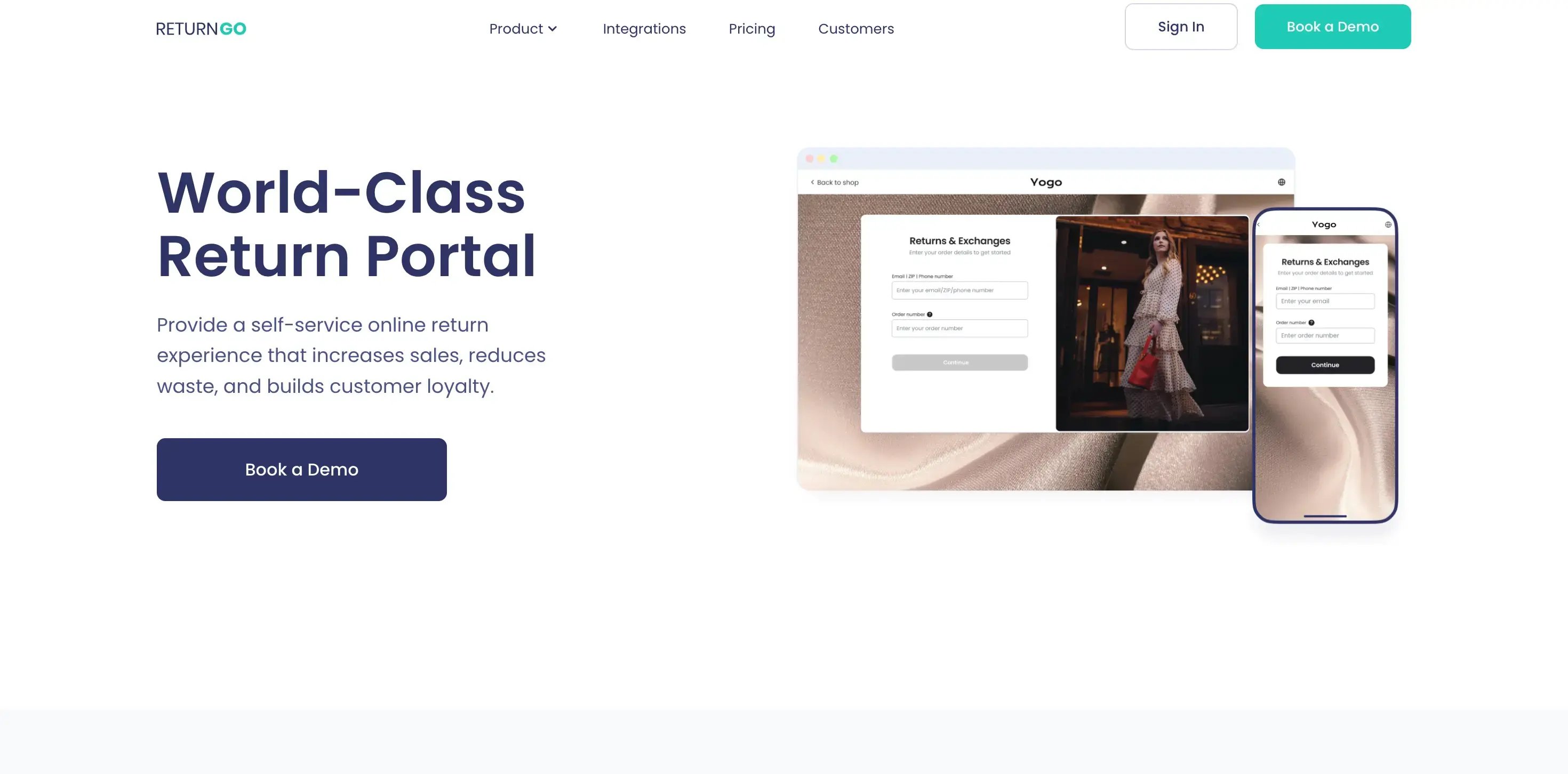
ReturnGO is a returns and reverse logistics platform built for e-commerce brands, especially Shopify merchants. It focuses on self-service returns with strong automation and exchange-first incentives. It scales from small DTC brands to larger teams by adding advanced rule logic and API-driven integration as volumes grow.
Key features
-
Branded portal with labels/QR codes and return tracking.
-
Exchange suggestions (size/color alternatives) to retain revenue.
-
Rules engine for eligibility, fees, final sale logic, and approvals.
-
Instant store credit and "shop now" flows to drive repurchase.
-
Multi-warehouse and international return logic support.
-
Sustainability options (keep/donate flows) for low-value returns.
-
Returns analytics to reduce avoidable return reasons.
Best for
-
Shopify-first brands with exchange-heavy categories.
-
DTC brands needing quick setup + deep automation potential.
-
Apparel and lifestyle retailers that are optimizing return costs.
Integrations
-
Shopify (native), Magento, Salesforce Commerce Cloud, BigCommerce
-
ShipStation, Shippo, Sendcloud, other shipping stacks
-
Zendesk, Gorgias, Klaviyo, Yotpo, WMS/3PL connectors
Pricing (2026): Starter: $23/month (up to 20 returns; extra returns billed). Premium: $147/month (up to 110 returns). Pro: $297/month (up to 300 returns). Enterprise: custom (often ~$417+/month starting point for larger volumes). Free trial: 14 days.
Pros
-
Strong exchange and store-credit conversion mechanics.
-
Flexible rules engine for policy control.
-
Good automation-to-effort ratio for lean teams.
Cons
-
The best experience is Shopify-centric.
-
Advanced rule setups can get complex without a dedicated operator.
8. nShift: Multi-Carrier Returns Management for Growing E-Commerce Operations
nShift is a delivery management platform with robust returns capabilities, focused on multi-carrier connectivity and automated return workflows. It scales well for growing e-commerce operations and 3PL environments that need standardized, repeatable return processes across carriers and geographies.
Key features
-
Branded self-service returns portal to reduce WISMO pressure.
-
Automated refund/exchange/restock workflows triggered by scans.
-
Exchange logic to convert returns into retained revenue.
-
Multi-carrier support for mail, lockers, and drop-offs.
-
Warehouse scan tools to speed receiving and decisioning.
-
Analytics and rules engine for approvals and exception handling.
Best for
-
E-commerce retailers that need to standardize multi-carrier returns.
-
3PLs and warehouses handling inbound returns at scale.
-
High-return categories that need exchange logic.
Integrations
-
Shopify, Magento, WooCommerce, Salesforce Commerce Cloud
-
SAP, Microsoft Dynamics, Oracle
-
Payment rails for automated refunds (where supported)
Pricing (2026): Essential: €8/month; Professional: €16/month; Premium: €149/month. (Final pricing may vary by contract and modules.)
Pros
-
Strong carrier connectivity and operational automation.
-
Good efficiency gains for warehouse and support teams.
-
Scales across markets as carrier complexity grows.
Cons
-
Platform breadth can introduce a learning curve.
-
Some advanced support may sit behind higher tiers.
9. ReBound: Enterprise Cross-Border Returns With a Global Carrier Network
ReBound combines returns technology with a global logistics network, positioning itself as a managed, omnichannel returns layer for enterprise brands. It supports localized returns through a carrier-and-hub model, which is valuable when cross-border returns costs and refund speed are major pain points.
Key features
-
End-to-end returns management (initiation to final destination).
-
Omnichannel returns support across e-commerce and retail touchpoints.
-
Access to 300+ carriers and 40+ regional return hubs (enables localized processing).
-
Operational impact claims include retention lift, NPS improvement, and reduced service requests (brand results vary).
-
Designed for enterprise-grade workflows (exchanges, refund triggers, tracking, and protection controls).
Best for
-
Enterprise brands with cross-border returns complexity.
-
Retailers that want network-backed returns execution (not just software).
-
Teams that prioritize faster refunds and localized consolidation.
Integrations
-
Shopify partnership positioning suggests deep alignment with the Shopify ecosystem.
-
Carrier and hub connectivity across regions.
-
(Additional ERP/WMS connectors are typically handled in enterprise onboarding.)
Pricing (2026): Not publicly listed; sold as an enterprise solution.
Pros
-
A network-backed model is strong for international returns economics.
-
Helps standardize returns across channels and countries.
-
Good fit when refund speed and local processing are strategic levers.
Cons
-
Quote-based enterprise buying process (less transparent).
-
Not ideal for SMBs that only need a lightweight portal.
How to Choose Reverse Logistics Software: 7-Step Decision Framework for 2026
Reverse logistics software is only "the best" if it matches how your returns actually flow: where items come back, who touches them, how decisions get made, and how quickly you need value back in inventory or resale. Treat this like an operating-model decision, not a feature checklist. The goal is to reduce return costs, protect customer experience, and increase recovery value without adding more manual work.
For brands operating on Shopify, complementing a reverse logistics platform with a purpose-built Shopify-native returns app ensures deeper storefront integration, faster RMA processing, and a more consistent customer experience.
1. How to Evaluate Scalability and Volume Fit in a Returns Platform
If the system cannot survive peak season, it is not scalable. Look for proof that the platform can handle your return spikes, multi-warehouse routing, and policy exceptions without breaking workflows.
What to evaluate
-
Peak readiness: Can it handle 2–3× return surges without workflow slowdown?
-
Multi-node support: Multiple warehouses, stores, repair centers, and resale partners.
-
Rule depth at scale: Rules should get sharper as volume increases, not harder to manage.
-
Multi-region capability: Tax, labels, and carrier options by country if you sell cross-border.
Questions to ask
-
What does onboarding look like at our return volume, and what breaks first?
-
How do you handle split orders, partial returns, and multi-SKU RMAs at scale?
Red flags
-
"Unlimited" claims with no reference architecture, no SLAs, and vague throughput language.
-
Core automation is locked behind enterprise tiers, with no clarity upfront.
2. What Does Reverse Logistics Software Actually Cost? Total Cost of Ownership Explained
Pricing is rarely just a subscription. Reverse logistics platforms often include implementation fees, per-return charges, label costs, add-ons (fraud, advanced analytics), and support tiers.
What to evaluate
-
Pricing model clarity: Subscription vs. per-return vs. blended pricing.
-
Implementation and integrations: One-time setup, custom workflows, ERP/WMS work.
-
Ongoing admin cost: How many operator hours per week to keep rules clean?
-
Carrier and label economics: Are you forced into specific label providers or rates?
Questions to ask
-
What will we pay at 10,000 returns/month, including add-ons and support?
-
Which features require paid professional services to configure or change later?
Red flags
-
"Custom pricing" with no range guidance or cost drivers explained.
-
If essential capabilities (basic rules engine, routing, reporting) are treated as paid add-ons.
3. Integration Depth and Data Quality: What to Look for in Reverse Logistics Systems
Reverse logistics fails when systems disagree. Your reverse logistics software must sync cleanly with your storefront, OMS, WMS, ERP, helpdesk, and finance workflows.
What to evaluate
-
ERP/WMS integration: Status sync, inventory recovery, and disposition updates.
-
RMA workflow mapping: From initiation to label/pickup, receipt, inspection, decision, refund/exchange, and restock/resale.
-
APIs and webhooks: Real-time updates, not CSV gymnastics.
-
Identity and permissions: Role-based access for CX, warehouse, finance, and ops.
Questions to ask
-
Can we push disposition outcomes into ERP/WMS automatically?
-
Can the platform trigger refunds/exchanges based on scan/inspection events?
Red flags
-
Integration is described as "available," but it's delivered via manual exports.
-
No clear event model (what triggers what) for refunds, restocks, and exceptions.
4. How to Evaluate Returns Policy Control and Automation in Your Platform
A reverse logistics platform earns its keep through decision automation: eligibility, routing, refunds vs. exchanges, fraud controls, and exception handling.
What to evaluate
-
Rules engine: Eligibility windows, SKU-level rules, customer segmentation, restocking fees.
-
Exchange-first tooling: Store credit, variant swaps, instant exchange logic where appropriate.
-
Smart routing: Cheapest and fastest path based on item value, condition, and location.
-
Exception handling: Damaged, missing items, late returns, and partial returns.
Questions to ask
-
Can we build different rules for high-value SKUs vs. low-value items?
-
Can we auto-approve standard cases and route exceptions to manual review?
Red flags
-
An "Automation" that is really just templated workflows with limited conditions.
-
No clean way to audit why a return was approved/denied (governance matters).
5. Sustainability and Compliance Features Every Reverse Logistics Platform Should Have
Sustainability is becoming operational. Reverse logistics software increasingly needs to track item outcomes, support repair/refurbishment, and document lifecycle decisions for audits and regulatory compliance. This is especially relevant for brands managing e-commerce supply chain complexity across multiple markets.
What to evaluate
-
Disposition tracking: Restock, refurbish, repair, resell, recycle, dispose, donate/keep-it.
-
Lifecycle documentation: Condition grading, repair logs, parts usage, resale channel output.
-
Reporting: Waste reduction, recovery value, and emissions signals where applicable.
-
Regulatory readiness: Especially relevant in regions moving toward product traceability requirements, such as the EU's Digital Product Passport direction under the Ecodesign for Sustainable Products Regulation.
Questions to ask
-
Can we prove what happened to returned inventory by SKU/serial number?
-
Can we operationalize repair/refurbishment without spreadsheets and manual handoffs?
Red flags: Sustainability claims that are marketing-only with no usable reporting or workflow support.
6. Support, Onboarding, and Operational Reliability: Questions to Ask Before You Buy
Reverse logistics touches customers, money, and inventory. Support quality and implementation rigor matter as much as features. Brands managing high-volume e-commerce returns processes cannot afford downtime or slow escalation paths.
What to evaluate
-
Implementation timeline and ownership: Who configures rules, integrations, and portals?
-
Support SLAs: Response time, escalation path, and availability during peak.
-
Change management: How safely can you change policies mid-season?
-
Security: Access controls, audit logs, and data retention.
Questions to ask
-
Who supports us during peak weeks and major policy changes?
-
How do you handle downtime, and what is your uptime history?
Red flags: No named implementation plan, no SLA commitments, vague "we are responsive" language.
7. How to Calculate ROI From Reverse Logistics Software: Recovery Value and Cost-to-Serve
Reverse logistics ROI is a mix of cost reduction, faster recovery, and better customer retention. Understanding your total logistics costs before and after implementation is essential for building a credible business case.
What to evaluate
-
Refund speed vs. fraud risk controls
-
Recovery value uplift: Restock speed, resale readiness, refurbishment throughput
-
Support ticket reduction: Fewer "where is my return/refund" contacts
-
Customer retention impact: Repeat purchase, store credit conversion, exchange rate
Questions to ask
-
What is the expected payback period at our return volume?
-
Which levers will move first in 30–60 days after launch?
The 5 Rs and 7 Rs of Reverse Logistics Explained (With Practical E-Commerce Examples)
Reverse logistics is not just "processing returns." It is a value-recovery system. The "Rs" frameworks are useful because they force clarity on outcomes, such as what happens to returned inventory and how you reduce waste while protecting margin. Understanding these frameworks is foundational to building a smarter reverse logistics strategy.
What Are the 5 Rs of Reverse Logistics?
Returns
The entry point: authorization, pickup/drop-off, and visibility.
-
Sets the customer experience baseline.
-
Creates the data trail for downstream decisions.
Resell
Getting sellable inventory back into a revenue channel fast.
-
Drives recovery value through fast restock or secondary resale.
-
Requires condition grading and channel rules.
Repair
Fixing economically repairable items.
- Reduces waste and improves recovery value on higher-AOV products.
- Needs controls for parts tracking, QA, and repair turnaround.
Repackage
Making items resale-ready when packaging is damaged.
-
Converts "good product, bad box" into recovered revenue.
-
Requires standardized repack workflows and quality checks.
Recycle (or Replace, depending on category)
Responsibly handling items that you cannot resell.
-
Protects compliance in electronics and regulated categories.
-
Reduces landfill and supports circular economy goals.
What Are the 7 Rs of Reverse Logistics?
This expanded version is more operationally specific and sustainability-oriented. It is especially useful for enterprise teams building structured supply chain operations around disposition and circular recovery.
Recover
Collect returned products efficiently and reliably.
-
Reduces leakage (lost items, untracked returns).
-
Improves turnaround time for value recovery.
Return
Move inventory backward through the supply chain with traceability.
-
Keeps warehouse and finance aligned on status.
-
Enables customer visibility and fewer escalations.
Repair
Restore function.
-
Supports warranty returns and after-sales logistics.
-
Improves reuse rates and reduces replacement cost.
Refurbish
Restore condition to "like-new" for resale.
-
Critical for electronics, appliances, and premium goods.
-
Increases resale value versus liquidation.
Repurpose
Use components or items for alternate use.
-
Salvages value from partial defects.
-
Supports parts harvesting strategies.
Recycle
Recover raw materials when product value recovery is not viable.
-
Supports regulatory compliance and ESG reporting.
-
Reduces disposal cost and environmental impact.
Resell
Monetize through primary restock or recommerce channels.
-
Makes reverse logistics a margin lever, not a cost sink.
-
Requires pricing logic, channel governance, and QA.
Important note: Some teams also reference the "7 rights" (right product, right customer, right time, right place, right condition, right quantity, right cost). That framework is useful for service-level discipline, but it differs from the reverse logistics "7 Rs" outcome model.
Reverse Logistics Trends in 2026: What's Reshaping Returns Operations Right Now
Reverse logistics is shifting from a back-office cost center to a strategic function tied to margin recovery, sustainability, and customer lifetime value. Staying ahead of these trends is increasingly important for any team evaluating reverse logistics software or rethinking their returns operating model. Here is what is shaping software decisions right now:
-
Sustainability moves into operations, not messaging. More brands are being pushed toward traceability and documented lifecycle outcomes. The EU's Ecodesign for Sustainable Products Regulation explicitly sets direction for digital product information and Digital Product Passport concepts. That will raise the bar for product lifecycle tracking over time.
-
Recommerce is becoming a default path, not a side project. Secondhand and resale markets keep expanding, which makes refurbishment workflows, grading standards, and resale integrations more valuable than "basic returns processing." ThredUp's resale reporting is one example of how quickly recommerce is becoming normal in retail planning.
-
AI shifts from dashboards to decisions. The most practical AI use cases are not flashy. They cover auto-triage, fraud pattern detection, disposition recommendations, and cost-based, item-value-based, and proximity-based routing optimization. Supply chain automation powered by AI is quickly becoming a competitive differentiator in returns management.
-
Customer experience expectations keep rising. Easy returns and fast, transparent refunds are no longer "delighters." They are table stakes, and failure is expensive. A strong post-purchase experience — including returns — directly drives repeat purchase and lifetime value. The NRF has repeatedly highlighted the scale and cost impact of returns across retail. That reinforces why returns automation matters.
-
WMS/ERP integration is becoming non-negotiable. As volumes grow, brands cannot afford reverse logistics systems that do not update inventory recovery, disposition, and financial status in near real time.
-
Fraud and abuse prevention is now a product requirement. Wardrobing, empty-box claims, and policy abuse require software to include risk scoring, evidence capture, and controlled instant refunds. Purpose-built e-commerce fraud prevention software is increasingly being integrated alongside or within returns platforms.
-
"Local-first returns" expand. More networks are pushing drop-off, consolidation, and localized processing to cut shipping costs and speed up inventory recovery, especially for cross-border brands.
Reverse Logistics Software FAQs: Buyer Questions Answered for 2026
What is reverse logistics software and what does it do?
Reverse logistics software manages the full return lifecycle: RMA creation, pickup/drop-off, return tracking, warehouse receiving, inspection, disposition decisions, and refunds/exchanges. The best platforms also connect repairs, refurbishment, recommerce, and analytics, ensuring that returns become measurable and improvable.
What is a reverse logistics system and how does it differ from a returns portal?
It is the end-to-end operating system for returns. It involves people, processes, carriers, facilities, and technology working together from authorization to final disposition. Reverse logistics software is the control layer that keeps every step traceable, automated, and policy-compliant — going well beyond a basic returns management portal.
What features matter most in reverse logistics software?
Start with a branded returns portal, RMA automation, a rules engine, real-time tracking, disposition workflows, and strong analytics. If you run high volume, prioritize WMS/ERP integration, fraud controls, and routing optimization to improve cost and speed. Teams focused on apparel should also consider returns solutions tailored to fashion stores.
How do I choose between an enterprise returns system and a Shopify-focused returns app?
If you need repair/refurbishment workflows, multi-warehouse routing, and deep ERP/WMS integration, you are typically in enterprise RMS territory. If your primary need is exchange-first flows, store credit, and faster portal setup, Shopify-native returns automation tools can be sufficient until complexity grows.
What are the 5 Rs of reverse logistics?
A practical version is Returns, Resell, Repair, Repackage, and Recycle (sometimes Replace, depending on category). It helps teams define what happens to returned goods and where value is recovered versus written off. For a deeper look at the underlying strategy, see our guide on what reverse logistics is and how it works.
What are the 7 Rs of reverse logistics?
A common sustainability-focused model is Recover, Return, Repair, Refurbish, Repurpose, Recycle, and Resell. It is useful for designing disposition paths that reduce waste while protecting recovery value. Brands tracking e-commerce return statistics often use this framework to benchmark their recovery performance.
Conclusion: Turn Returns Into a Profit and Customer Trust Advantage
Reverse logistics is not just about getting items back. It is about recovering inventory value faster, reducing cost-to-serve, and keeping the customer experience intact when something goes wrong. The right reverse logistics software gives you control over rules, routing, disposition, and visibility, so your team spends less time firefighting and more time improving outcomes. For brands ready to go deeper, exploring how reverse logistics companies and managed service providers complement software platforms can open up additional cost and efficiency levers.
Your next steps
-
Map your end-to-end return lifecycle and quantify where money leaks today (support tickets, slow refunds, poor disposition, inventory write-offs).
-
Shortlist two to three platforms that match your volume and complexity.
-
Run a proof of concept using real return scenarios: standard returns, exchanges, partial orders, damaged items, and high-risk claims.
-
Evaluate success using processing time, recovery value, customer satisfaction, and total return cost per order.