%20%20-%20Menu.svg)




.png?width=879&height=549&name=Page%2074%20(1).png)



In this blog
This article explores the essential role of an order management specialist, highlighting their core responsibilities, how their function intersects with other supply chain roles, and the day‑to‑day processes that define their work. It also discusses the skills that differentiate great specialists from good ones, along with the challenges they encounter. Additionally, the article underscores why order management specialists are indispensable to the growth of e‑commerce businesses. Ultimately, it serves as a valuable guide for business leaders and hiring managers seeking to strengthen their supply chain operations with proven expertise.
Order management is where promises turn into parcels. Between the cart click and the doorstep handoff, the order management specialist keeps every moving piece aligned. That includes validating demand, synchronizing inventory, orchestrating carriers, and smoothing customer interactions when something goes off‑script.
Put the right person in this station and cycle times shrink, errors fall, and the company gains the repeatable cadence modern commerce demands. This role is increasingly shaped by a shifting technological landscape.
The global warehouse automation market, which underpins fulfillment and order processing efficiency, was valued at USD 31.21 billion in 2025 and is projected to grow to nearly USD 120 billion by 2034, reflecting rapid adoption of robotics, AI and automated systems across logistics and e‑commerce operations.
This shift in technology reshapes the toolkit of order management specialists, making fulfillment accuracy a critical competitive edge. This article explores the essential role of an order management specialist, highlighting their core responsibilities, how their function intersects with other supply chain roles, and the day‑to‑day processes that define their work.
It also discusses the skills that differentiate great specialists from good ones, along with the challenges they encounter. Additionally, the article underscores why order management specialists are indispensable to the growth of e‑commerce businesses. Ultimately, it serves as a valuable guide for business leaders and hiring managers seeking to strengthen their supply chain operations with proven expertise.
How Order Management Specialists Control the Entire Order Lifecycle
An order management specialist oversees the entire lifecycle, from order entry to shipment confirmation. They validate payment and tax rules, verify inventory levels, confirm delivery dates, and coordinate purchase orders or replenishment if stock is constrained. Unlike a warehouse lead focused on picking efficiency or a support agent focused on call resolution, this position manages the connective tissue (data, timing, and handoffs) to ensure that planning assumptions align with operational reality.
Equally important, the specialist is the control tower for exceptions. When the address quality, substitutions, partial shipments, split consignments, or compliance flags arise, they adjudicate options within order management systems and escalate to internal departments only when policy requires. The role is different from generic coordination in that decisions are embedded in the order fulfillment process, measured in minutes, and audited later through accurate records and service metrics.
What Are the Daily Responsibilities of an Order Management Specialist?
Before responsibilities splinter into tasks, note the through‑line: protect customers from friction while preserving margin discipline. A capable specialist strikes a balance between speed and compliance, enforcing guardrails for professional development without slowing down delivery.
How Do Order Management Specialists Validate and Process Incoming Orders?
The specialist ensures that customer orders are captured cleanly across channels and that each record complies with tax, fraud, pricing, and company rules. Clean intake reduces downstream rework and helps the business work effectively during peaks. Dedicated order entry software and order processing platforms are central to this step.
How Do Specialists Coordinate Inventory Allocation Across Multiple Locations?
They reconcile inventory levels across locations and channels, trigger backorders as needed, and determine splits or substitutions. Correct allocation prevents overselling, stabilizes cycle time, and ensures customer-focused promises, such as timely delivery. Working closely with inventory management companies and systems is essential to keeping this process accurate.
What Cross-Functional Teams Do Order Management Specialists Work With?
Specialists align cross-functional teams — including Warehouse, Procurement, Finance, and Support — to ensure exceptions do not stall. They translate signals from planning into executable pick waves and confirm carrier cutoffs with various departments to keep the queue moving. Understanding e-commerce supply chain management end-to-end is key to bridging these teams effectively.
How Do Order Management Specialists Handle Exceptions and Escalations?
From payment failures to damaged goods or address validation issues, the specialist triages exceptions quickly. They document outcomes, uphold company policies, and initiate corrective actions with reasonable accommodation to minimise customer impact. When shipping delays or carrier failures occur, the specialist coordinates resolution across internal teams.
What Is the Role of Order Management Specialists in Shipment Confirmation and Delivery Tracking?
They monitor order status, release shipments, and coordinate notifications so customers know what to expect. Clear communication lowers customer inquiries and supports exceptional customer service during issues. Leveraging e-commerce order tracking tools ensures customers always have visibility into their shipment status.
How Do Order Management Specialists Process Returns and Exchanges?
The specialist processes RMAs, exchanges, and credits with attention to accuracy. Effective returns control safeguards margin and keeps clients confident, especially in logistics-heavy categories. The use of returns management software and structured returns process workflows directly affects how smoothly this function operates.
Why Is Reporting and Continuous Improvement Critical for Order Management Specialists?
They maintain accurate records, perform daily data entry checks, and surface insights that improve the process. Reporting informs buying, inventory control, and carrier negotiations. It closes the loop between planning and fulfillment.
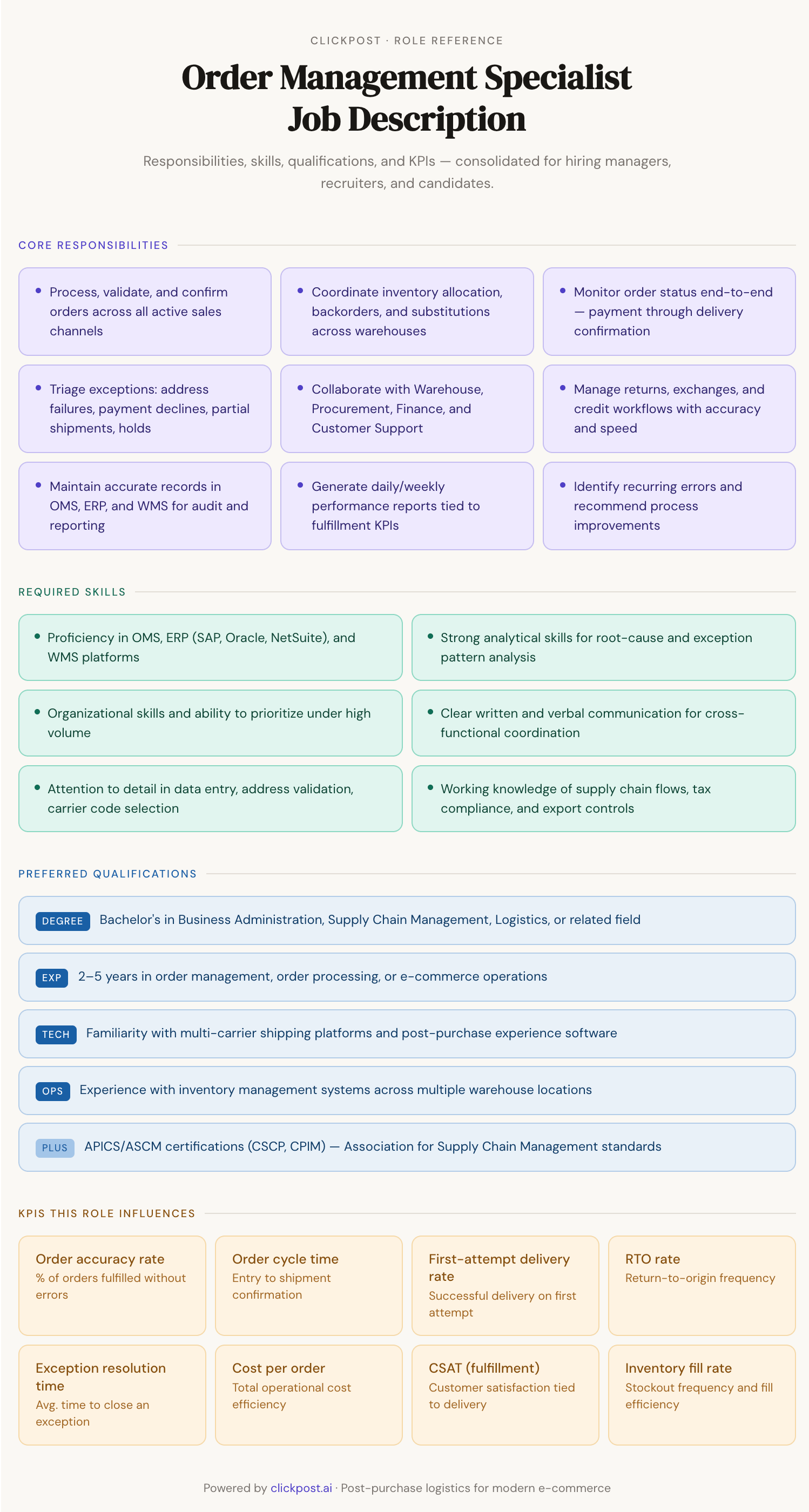
Order Management Specialist Job Description: Responsibilities, Skills, and Qualifications
This section consolidates the role into a structured job-description format for hiring managers, recruiters, and candidates evaluating the position.
What Skills Do the Best Order Management Specialists Have in 2026?
Performers in this seat blend systems fluency, operational judgment, and people sense. They must have a strong attention to detail and the ability to be responsible for every employee during their paid time. The following skills are decisive.
What Order Management Software and Tools Should Specialists Master in 2026?
A specialist needs a solid understanding of order management software, WMS, ERP, and e-commerce shipping software. They must hop among management software screens without losing context, sustaining accuracy when pressure is high and time is limited.
How Do Analytical Skills Help Order Management Specialists Find and Fix Root Causes?
Pattern recognition turns raw exceptions into root causes. With strong analytical skills, the specialist identifies anomalies in order processing that are linked to upstream catalog, pricing, or replenishment errors and helps resolve them.
Why Are Organizational and Prioritization Skills Essential for High-Volume Order Management?
High volume means triage. Excellent organizational skills ensure SLAs remain intact; the specialist sequences work by impact, not noise, and then documents decisions to preserve institutional knowledge and health.
How Do Order Management Specialists Communicate Effectively With Internal and External Stakeholders?
Clear language keeps departments aligned. Specialists explain constraints to customers, negotiate trade-offs with other departments, and de-escalate when trade-offs are unavoidable. They still deliver excellent customer service.
What Supply Chain and Compliance Knowledge Do Order Management Specialists Need in 2026?
A working grasp of e-commerce logistics, tax, and export controls helps the specialist choose compliant paths. This knowledge reduces escalations and protects the business.
How Does Attention to Detail Under Pressure Prevent Costly Order Errors?
Real performance is evident in micro-decisions — including address formats, unit conversions, and carrier codes. Detail discipline prevents order-related issues that can ripple across the organization.
Tools and Software Used by Order Management Specialists in 2026
The modern order management specialist works across multiple systems daily. Below are the categories and examples that define a typical tech stack.
-
Order Management Systems (OMS): Platforms like Salesforce Order Management, IBM Sterling, or Fluent Commerce serve as the central hub for order capture, routing, and lifecycle tracking.
-
Enterprise Resource Planning (ERP): Systems such as SAP S/4HANA, Oracle ERP Cloud, and NetSuite unify finance, procurement, and inventory data, giving specialists a single source of truth for order validation.
-
Warehouse Management Systems (WMS): Tools like Manhattan Associates, Blue Yonder, or HighJump manage pick-pack-ship workflows that the specialist coordinates upstream. A dedicated warehouse management system is essential for real-time inventory accuracy.
-
Shipping and Carrier Management: Multi-carrier platforms handle label generation, rate comparison, and tracking. ClickPost falls in this category and extends into post-purchase experience management (covered in the dedicated section below).
-
Returns Management Platforms: Dedicated reverse logistics tools or built-in OMS modules handle RMA creation, refund processing, and restocking workflows.
-
Analytics and BI Tools: Specialists use dashboards in Tableau, Looker, or native OMS reporting to monitor KPIs, spot exception trends, and feed insights back into planning. Fluency across these systems — and knowing how data flows between them — is what separates a competent specialist from one who drives continuous improvement.
Order Management Specialist Salary in 2026: US, India, and Remote Roles
Salary varies by geography, experience level, industry, and whether the role is remote or on-site. Below are indicative ranges drawn from third-party compensation platforms.
United States: According to Glassdoor, the average base salary for an order management specialist in the US ranges from approximately $45,000 to $65,000 per year, with senior or lead roles in high-cost metros reaching $70,000–$80,000+. Salary.com lists similar ranges, with total compensation (including bonuses) pushing higher at companies with performance-linked pay.
India: Salary data from AmbitionBox and Glassdoor India suggests a typical range of ₹4.0 lakh to ₹8.0 lakh per annum for mid-level specialists, with senior roles at large e-commerce companies in India or logistics companies exceeding ₹10 lakh.
Remote Roles: Remote order management specialist positions have grown alongside e-commerce expansion. Compensation for remote roles typically mirrors the employer's home-market rates, though some companies adjust for the candidate's cost of living.
Order Management Specialist vs Order Manager: What's the Difference?
The two titles are sometimes used interchangeably, but they typically differ in scope and seniority.
An order management specialist is an individual contributor focused on day-to-day order processing, exception handling, and system-level execution. They work within established SOPs and escalate policy-level decisions.
An order manager usually carries broader responsibility: team leadership, process design, vendor negotiations, and ownership of fulfillment KPIs at a departmental or regional level. They set the SOPs that specialists follow and own the performance targets the team is measured against.
In smaller organizations, one person may fill both roles. In larger e-commerce fulfillment operations, the distinction matters for hiring, career pathing, and compensation benchmarking.
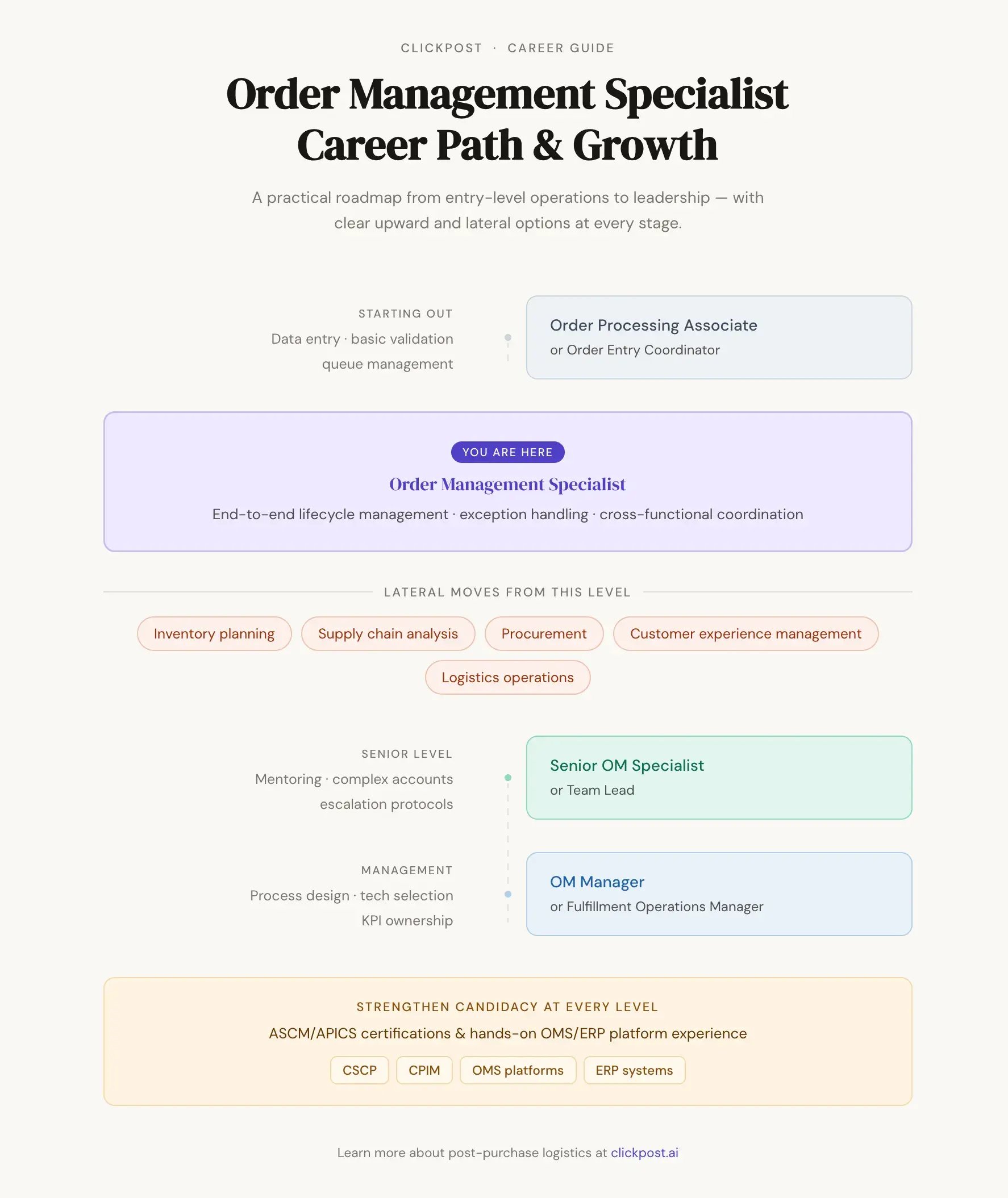
Order Management Specialist Career Path and Growth Opportunities
Order management is a practical entry point into supply chain and e-commerce operations, with clear upward and lateral movement.
Why Are Order Management Specialists Critical for Scaling E-Commerce in 2026?
E-commerce scales only when the back office scales with it. The order management specialist provides the throughput control that keeps promises feasible as catalogs, channels, and geographies multiply. With consistent governance over order status, allocations, and carrier cutoffs, they protect customer satisfaction while containing cost per order. Their decisions determine whether marketing wins compound or evaporate in exceptions. In short, it plays a truly crucial role in achieving sustainable growth.
How Order Management Specialists Enable Channel Expansion Without Operational Chaos
As marketplaces and DTC sites expand, the specialist harmonizes services and policies to ensure a seamless experience. It allows assortments to stay coherent and SLAs to remain credible. Managing B2B e-commerce supply chains alongside DTC channels adds further complexity that only a skilled specialist can navigate.
How Specialists Maintain Real-Time Inventory Accuracy That Customers Can Trust
Reconciling inventory levels in near real-time helps avoid overselling and stockouts, reducing cancellations and keeping customers confident. When paired with automated supply chain automation, specialists can govern inventory across dozens of SKUs and locations without manual errors.
Why Faster, Cleaner Order Handoffs Reduce Cycle Time and Fulfillment Costs
Crisp orchestration minimizes idle time between picking, packing, and delivery, accelerating cycle time without compromising accuracy. Leveraging automated shipping tools at this stage compounds the efficiency gains.
How Clean Order Data Improves Future Buying, Inventory, and Carrier Decisions
Clean, accurate records and exception tags fuel smarter buys, leaner safety stock, and better carrier routing next week, not just today. This is the core value of a disciplined post-purchase experience strategy — insights gathered downstream inform every upstream decision.
What Are the Biggest Challenges Order Management Specialists Face and How to Solve Them?
Even elite teams wrestle with messy inputs: inconsistent catalog data, fluctuating lead times, and seasonal spikes. Below are common obstacles and pragmatic remedies.
How Can Order Management Specialists Overcome Omnichannel Complexity in 2026?
The challenge: Orders now originate from web stores, marketplaces, stores, and social commerce platforms. Without tight integrations, data drifts and duplicate records appear. The load on the specialist increases, and customers feel it through mis-promising and delays.
How to overcome it: Consolidate flows in modern order management systems and centralize label creation, tracking, and events. With ClickPost, multi-carrier connections and shipment events unify post-purchase tracking, allowing specialists to govern from a single pane of glass and resolve order-related issues before they escalate.
What Solutions Fix Inventory Visibility Gaps That Cause Order Cancellations and Expedites?
The challenge: Inaccurate inventory levels drive cancellations or emergency expedites, eroding margins. When locations are out of sync, promising becomes guesswork.
How to overcome it: Enforce cycle counts and API-level syncs between ERP, WMS, and OMS. ClickPost augments this by reflecting live scan events and exception codes, allowing specialists to re-route or split shipments rapidly to keep timely delivery feasible.
How Can Order Management Specialists Reduce RTO Rates and Fix Address Quality Issues?
The challenge: Address-related errors, failed deliveries, and missed appointments balloon costs and harm customer satisfaction.
How to overcome it: Bake address validation into order entry and utilize proactive notifications. ClickPost's NDR workflows and configurable messages reduce RTO, while analytics highlight hotspots, allowing specialists to partner with internal departments to address root causes.
How Do Order Management Specialists Handle Peak Season Surges and Staffing Constraints?
The challenge: Peak demand strains staffing, resulting in backlogs and shortcuts that compromise accuracy.
How to overcome it: Pre-build surge playbooks: flex labor, trim nonessential steps, and tune cutoffs. ClickPost automates carrier selection and bulk actions, allowing specialists to clear queues faster without compromising compliance with company policies.
What Tools Help Order Management Specialists Manage Carrier Disruptions and Delivery Failures?
The challenge: Weather, capacity limits, and regional outages disrupt plans; delivery promises wobble.
How to overcome it: Maintain diversified routing rules and contingency carriers. ClickPost's routing intelligence suggests alternatives automatically, while unified order status keeps customers informed.
How ClickPost Supports Order Management Specialists: Platform Overview and Integration
ClickPost is a post-purchase and shipping experience platform built to reduce the operational load on order management specialists while improving delivery performance and customer satisfaction. Rather than replacing OMS or ERP systems, ClickPost sits downstream and connects fulfillment execution to the customer-facing experience.
What ClickPost Does for Order Management Teams
Multi-Carrier Integration and Smart Routing: ClickPost connects with 600+ carriers globally through a single API. Specialists set routing rules based on serviceability, SLA, cost, or carrier performance, and the platform allocates shipments automatically. This eliminates manual carrier selection and speeds up dispatch.
Unified Tracking and Branded Notifications: All shipment events from every carrier are normalized into a single tracking feed. Branded tracking pages and proactive notifications (via email, SMS, or WhatsApp) keep customers informed without the specialist fielding status inquiries manually.
NDR Management and RTO Reduction: When a delivery attempt fails, ClickPost's NDR workflows trigger automated outreach to the customer to reschedule, confirm the address, or update preferences. This reduces return-to-origin rates and the cost associated with re-attempts.
Automated Returns and Exchange Management: ClickPost streamlines reverse logistics with self-serve return initiation, automated approval rules, and carrier assignment for pickups. This reduces manual processing time and accelerates refund or exchange cycles, effectively functioning as a purpose-built returns management platform.
Analytics and Performance Dashboards: Shipment-level data feeds into dashboards that surface delay patterns, carrier SLA adherence, first-attempt delivery rates, and RTO trends. Specialists and managers use these insights to adjust routing rules, flag underperforming lanes, and inform carrier negotiations.
How ClickPost Integrates With Inventory Management and Fulfillment Systems
ClickPost is designed to work alongside existing inventory management and fulfillment infrastructure, not replace it.
-
ERP and OMS Integration: API-based connectors sync order data from platforms like SAP, Oracle, NetSuite, Salesforce Order Management, and custom OMS builds. When an order is confirmed and allocated, ClickPost picks it up for carrier assignment and label generation.
-
WMS Connectivity: Shipment-level status updates flow back into warehouse management systems, so inventory records reflect actual dispatch and delivery outcomes, not just planned ones.
-
Storefront and Marketplace Sync: ClickPost integrates with Shopify, Magento, WooCommerce, and major marketplaces, pulling orders directly and pushing tracking data back to the storefront for customer visibility. This makes it particularly valuable alongside Shopify order tracking workflows.
- Returns to Inventory Loop: When a return is completed and received at the warehouse, ClickPost's data helps inventory management systems update available stock, closing the loop between reverse logistics and sellable inventory.
Building a Complete Order Management Package for E-Commerce Growth
Great e‑commerce is not just a tech stack; it is a discipline. The order management specialist turns fragmented inputs into dependable outcomes. It is a comprehensive package that includes predictable delivery, clean handoffs, and resilient operations. Equip this role well, and growth stops feeling like a strain.
Frequently Asked Questions About Order Management Specialist Roles
What does an order management specialist do on a daily basis?
An order management specialist supervises the journey from order entry to shipment and returns. Daily tasks include validating purchase orders, aligning with warehouse and finance teams, monitoring order status across channels, triaging exceptions such as payment failures or address errors, and maintaining accurate records for audit and reporting.
How much does an order management specialist make in 2026?
In the United States, base salaries typically range from $45,000 to $65,000 per year, with senior roles in major metros reaching $70,000–$80,000+, according to Glassdoor. In India, the range is approximately ₹4.0 lakh to ₹8.0 lakh per annum for mid-level roles, with senior positions exceeding ₹10 lakh. Compensation varies by geography, industry, and experience.
What skills and tools should order management specialists master in 2026?
Core skills include proficiency with order management software, ERP (SAP, Oracle, NetSuite), and WMS platforms, along with strong organizational skills, communication ability, and analytical thinking. Familiarity with multi-carrier shipping platforms, returns management tools, and BI dashboards rounds out the toolkit.
How does the order management specialist role impact company profitability?
The role converts demand into dependable revenue by reducing order errors, lowering cost per order, and minimizing churn caused by fulfillment failures. Specialists stabilize inventory control, enforce realistic delivery dates, and elevate customer satisfaction, which directly supports retention and cash flow.
What are the most common order management challenges in 2026?
Typical hurdles include fragmented systems, unreliable inventory visibility, peak-season backlogs, last-mile delivery variability, and rising customer expectations around speed and transparency. Solutions involve integrated logistics management software, real-time tracking, automated exception handling, and disciplined SOPs.
What is the difference between an order management specialist and an order manager?
An order management specialist is typically an individual contributor handling daily order processing, exceptions, and system execution. An order manager usually carries broader responsibility, including team leadership, process design, vendor negotiations, and KPI ownership at a departmental level.
Is an order management specialist a good career in 2026?
Yes. The role offers a clear career path from entry-level order processing into senior specialist, team lead, and operations management positions. It builds transferable skills in systems thinking, cross-functional communication, and supply chain operations that are valued across e-commerce, retail, manufacturing, and logistics.
What software do order management specialists use?
Common platforms include order management systems (Salesforce Order Management, IBM Sterling, Fluent Commerce), ERP systems (SAP, Oracle, NetSuite), warehouse management systems (Manhattan Associates, Blue Yonder), multi-carrier shipping platforms (such as ClickPost), returns management tools, and BI/analytics dashboards.
What KPIs does an order management specialist track?
Key metrics include order accuracy rate, order cycle time, first-attempt delivery rate, return-to-origin (RTO) rate, exception resolution time, cost per order, customer satisfaction score (CSAT), and inventory fill rate.
Can order management specialists work remotely?
Many companies now offer remote or hybrid arrangements for this role, particularly in e-commerce. The work is system-driven and communication-heavy rather than physically tied to a warehouse floor, making it well suited to remote setups provided the specialist has reliable access to OMS, ERP, and communication tools.